Thursday, 7 June 2012

Backwater valves


Basement flooding can be caused by a number of reasons including cracks or leaks in basement walls, blocked pipes, failure of foundation drains (weeping tiles) and poor lot drainage. Heavy rain events can also overload city sewer systems and lead to sewage backing up through house sewer lines and flowing into unprotected basements. Damage from sewer backups is costly for homeowners and municipalities. The Canadian insurance industry pays an estimated $1.7 billion each year in claims due to water damage. 

A backwater valve is a flood-proofing device that prevents sewage in an overloaded public sewer system from backing up into your basement. This fixture, placed on a sewer line in your basement, works as a one way system - sewage can go out, but not back in. The backwater valve automatically closes if sewage backs up from the main sewer line. You should contact a licensed plumber to install a mainline backwater valve and to obtain the proper plumbing permits.

Backwater valve (source: plumber-master.com)
 
Since decades ago, the National Plumbing Code has required the installation of a backwater valve. In HRM, construction or renovation projects have been required to follow the National Plumbing Code including the installation of backwater valves. This became more closely monitored after HRM amalgamation in 1996, when all of HRM required inspections with the issuance of a permit for construction or renovation projects.

Today you are required to get a construction permit (and inspection) for any renovation or construction exceeding $5,000 or when performing structural work. This would include adding or altering a connection to the storm or ssystem such as installing a backwater valve (the only exemption is when replaceing a plumbing fixture).

For more tips on reducing the risk of basement flooding, check out this brochure and video provided by the Insurance Bureau of Canada.

Friday, 25 May 2012

Drainage and your property

Proper drainage around your home will help reduce risk of basement flooding, reduce problems with your basement foundation (cracking, shifting), extend the life of your sump pump and reduce the volume of water that flows into the sewer system. The Canada Mortgage and Housing Corporation (CMHC) recommends 3 principles to improve water management on your property.


 1. Drain water away from your house and avoid causing drainage problems on neighbouring properties. 

  • Build up the ground around your house so that water flows away from your basement walls. CMHC recommends at least a 5% slope away from your foundation walls and a 2% slope for impermeable surfaces next to your house (driveway/patio).
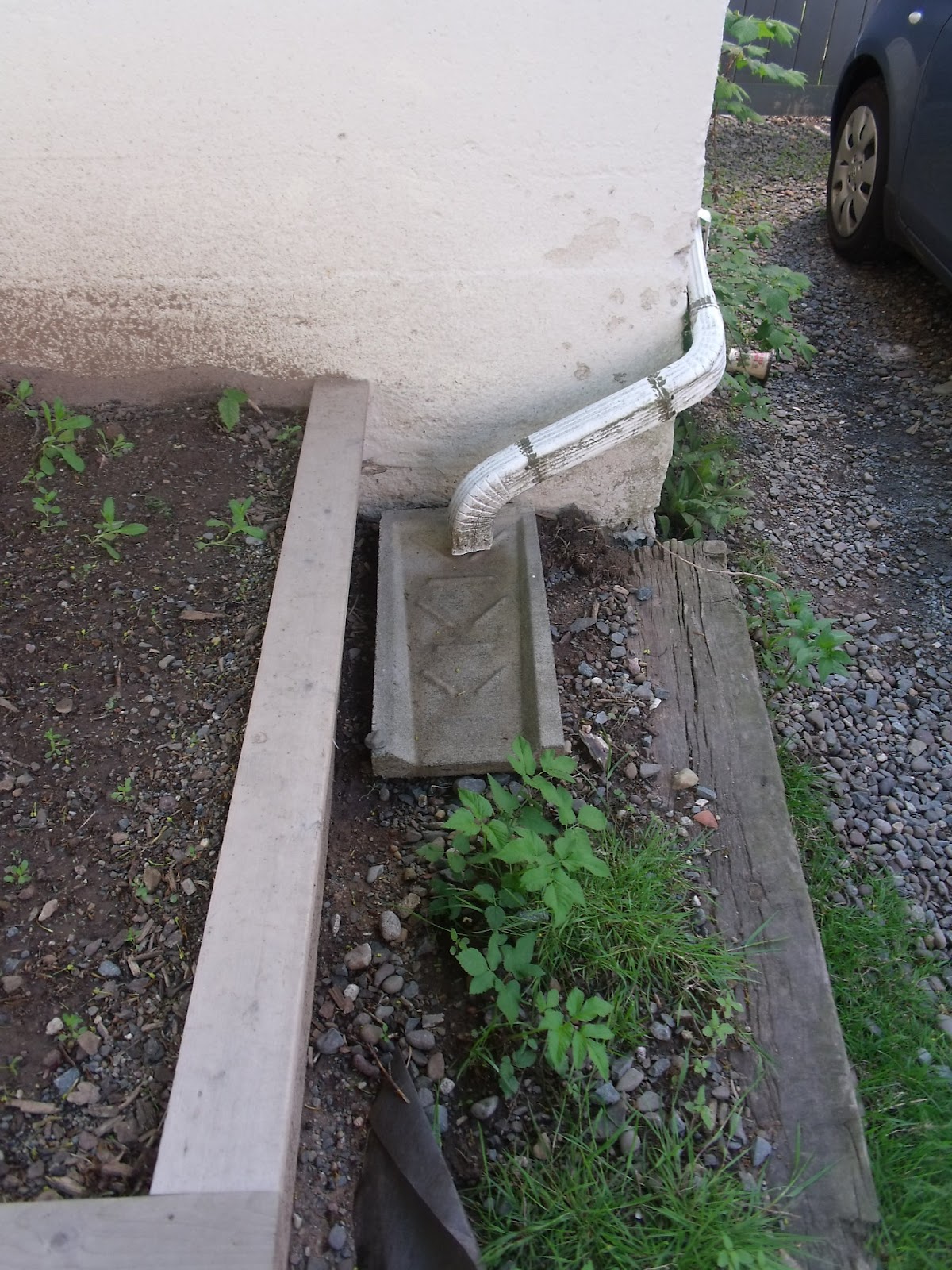
  • Disconnect your downspouts if they are directly connected to your home's sewer system. Place an extension on your downspouts to direct roof runoff at least 4 m away from your house so that water doesn't pool next to your basement. The extension can direct water toward a rain garden or backyard where it can soak into the ground without causing problems. Use a splash pad, pebbles or crushed rock to absorb the impact of water and prevent soil erosion. 
  • A French drain or bioswale can also be used to convey water away from your home. If you have a waterfront property and your runoff is being conveyed directly into a water body, try to add some curves or pooling areas to your conveyance system to slow down the water and allow sediment and other pollutants to settle out. 


Remember to disconnect your downspouts!


Extend your downspout so water drains away from  your house
Use a splash pad to prevent erosion
     2. Let runoff soak into the ground on your property
       

  •      Limit the amount of paved or other hard surfaces. Use permeable pavers, paved driveway strips or gravel for increased driveway permeability.
  •      Direct water toward a rain garden, which should be at least 4 m from your house. Rain gardens work great for everyday rain events, however it is important to consider designing an overflow system (swale or perforated pipe) to help convey excess water toward the street during a heavy rainfall event. 
  •      Soil aeration can reduce compaction and allow better infiltration. Water pooling on your property for an extended period is a good indication that your soil may need aeration.
 

If possible, reduce large paved areas
Modular paving stones, or permeable pavers, allow water to infiltrate into the ground
    3. Capture and reuse water

  •      Place a rain barrel under your disconnected downspouts to capture rooftop runoff. Elevate the barrel above ground level so that a tap or hose can be installed for easy water collection.


Raised rainbarrel system. Photo: The Transplanted Gardener
      Visit  the Canada Mortgage and Housing Corporation website for more practical information on how to improve drainage on your property to avoid basement flooding.

Friday, 18 May 2012

12,000 rain gardens

The Puget Sound region of Washington State is tackling water quality issues with a new campaign to install 12,000 rain gardens by 2016. Once completed, these rain gardens will soak up 160 million gallons of polluted stormwater runoff each year. This innovative campaign offers financial incentives and comprehensive educational materials to neighbourhoods as a way to encourage individuals to do their own part to reduce the amount of pollutants entering the environment while solving drainage problems around their own homes. By encouraging individuals to become neighbourhood champions and recruit others, entire neighbourhoods are coming together to learn about and install rain gardens.The campaign currently has 706 raingardens installed.

Check out the website to find some great resource materials and learn more about the program.

Thursday, 3 May 2012

Constructed wetlands

"S" shaped constructed wetland
At the headwaters of Frenchman's Creek in Dartmouth, a wetland was constructed to treat stormwater runoff from the adjacent sports fields and parking lot. The wetland has a serpentine shape and varying depths in order to maximize residence time of the runoff in the wetland. This allows for increased removal of nutrients and metals through plant uptake and adsorption. This stormwater treatment feature essentially acts as a kidney purifying the water. The runoff leaving this site now enters the natural environment at a much higher quality than it would if directly released without treatment. 


This wetland would require occasional maintenance to maximize function. Construction was done by Jeff Pinhey and Rob Leblanc in 2007. 

The marsh is predominantly vegetated with cattails

Wednesday, 25 April 2012

Urban Forests

What is a simple action that homeowners can take to reduce stormwater runoff leaving their property? Plant a tree.
h
 Trees and forests benefit air quality, biodiversity, neighbourhood aesthetics and also play an essential role in managing stormwater. Tree canopies reduce stormwater runoff by intercepting, capturing and storing rainfall and releasing water into the atmosphere through evapotranspiration. In urban and suburban settings, a single deciduous tree can intercept between 500-760 gallons (~1,800-2,800 L) per year, while a mature coniferous tree can intercept over 4,000 gallons (~15,000 L) per year (PA Trees). In addition, tree roots and leaf little help promote infiltration of runoff into the soil.


Source: http://bit.ly/IcxK5H
Trees also act as filters, taking up nutrients and contaminants from the ground that may otherwise directly enter natural water bodies, or end up in wastewater treatment plants. As we begin to remove forest canopy and replace it with lawns and impervious surfaces, we immediately have an impact on quality and quantity of stormwater runoff. 
h
Urban Forests in Halifax Regional Municipality             
                                                               
In HRM, it is estimated that street trees provide about $2.1 million in stormwater reduction services annually (HRM). HRM is currently developing an Urban Forest Master Plan (UFMP) with the goal of ensuring a sustainable future for our urban forest. The plan contains an overview of the issues and opportunities regarding sustainable urban forest management in HRM. Neighbourhood Factsheets have also been developed that describe the species composition and age distribution of trees found in each neighbourhood, as well as targets for urban forest restoration. Take a look at the draft UFMP and Neighbourhood Factsheets here. 

Monday, 16 April 2012

Stormwater Management at Dalhousie University

A group of students enrolled in “Campus as a Living Lab”, a course at Dalhousie University that aims to engage students in efforts to “green” the campus and surrounding areas, have delved into the world of stormwater management. Students, Bridgette DeCoste, Tiara Pettinger, Robyn Pirie, Nicole Power, Michelle Simone and Paul Westlund, chose two areas on campus, the Dunn parking lot and the Grad House, to focus their research. The intention was to create transferable stormwater management designs that could be implemented by homeowners who are interested in managing stormwater on their properties. The students created three levels of increasingly complex designs for both sites and investigated five different management approaches; vegetated swales, permeable pavement, rain gardens, rain barrels, and French drains. The students then presented their designs to experts in the field, as well as with facilities management staff at Dalhousie to determine the most feasible and cost-effective approach to stormwater management on the two sites.

Here are graphics of the third designs for each location

Dunn Parking lot - featuring permeable pavement and vegetated swales

  
Grad House- featuring french drain, rain barrels and rain gardens


The most interesting part about this report for the Ecology Action Centre is the transferability of the designs. Because each component of their designs is featured individually as well as a part of the whole system, the report contains a wealth of information directly relatable to any homeowner who’s looking into taking on some of these retrofits on their own properties. The report also contains several appendices including tables with a complete breakdown of all the costs associated with these retrofits, and a list of water-loving plants native to Nova Scotia, for installation in the rain gardens.

Thanks to all the students for their excellent work.