Showing posts with label Dalhousie University. Show all posts

Wednesday, 16 October 2013

Dalhousie Rain Garden is Complete!


There’s a new rain garden in town! With funding from TD Friends of the Environment, the Coastal and Water Team at the EAC was able to partner with Dalhousie’s Office of Sustainability to build a rain garden on the Dalhousie Campus.  Our site is a challenging one, in that it receives high flows of stormwater during heavy rains, enough to cause basement flooding of several buildings down the hill toward the Northwest Arm. The garden is located at the intersection of Coburg Rd and Oxford Rd, at the School of Social Work ‘house-turned-office’.  While our goal was initially to build a rain garden that demonstrates that this is an accessible DIY project for homeowners, this site and the design it required moved the project out of the DIY category!  However, there are many aspects of the design and build process that still apply to a homeowner excited about a rain garden sized for capturing rainwater from a roof via a downspout or two.

Our Process & Design
First, we assessed the site, which means that we looked at a variety of factors that will influence how water moves over the site. This includes soil type and drainage properties, slope, and the size of the rain catchment area. Check out previous rain garden how-to posts here for details on these steps.

Our calculations showed that we needed a very large garden to absorb all the stormwater which we calculated flowed onto the site. In fact, the calculated area was larger than the area we had available! In addition, we found the slope of the site to be steeper than the suggested 12% for rain gardens in even the flattest area. This meant that we had to increase the capacity of the garden not by surface area, but by depth. The garden is 24 inches deep, whereas most rain gardens are 6-8 inches deep. To increase the porous volume in the garden, we filled the depression to a depth of 14 inches of clear stone, which would hold water in the bottom of the garden, while also holding soil on top. The cross-sectional design looked much like this diagram, from the Fairfax County Virginia website (Figure 1).
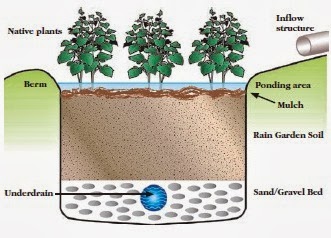
Figure 1. Approximate cross-sectional view of the rain garden at Dalhousie.

We used drainage tile (underdrain in the diagram) to move the stormwater that flows from the road and sidewalk over the steep hillside into the rain garden. See the photo below (Figure 2).


Figure 2. In the middle of this photo, the drainage tile is sticking out of the clear stone in the middle of the garden. The tile extends back to where the volunteers are sitting on the slope to catch water flowing down the slope and direct it into the rain garden.

In this photo (Figure 2) you can see how deep the garden is and just how much clear stone is at the bottom. And another key design feature is starting to form: the berm! The berm is essential in a garden of this size, on this slope, and so close to the house. The berm will help retain the water in the garden while it pools and infiltrates. Below (Figure 3) you can see how the berm has been planted with larger native shrubs such as sweet fern and bayberry, as well as a serviceberry tree. As these plants establish, they will help anchor the berm in place. To increase the strength of the berm, it was constructed out of sod mats from the beginning of excavation. Each layer was tamped down, and then new sod was staked into the backside of the berm all the way around the edge of the garden.

Figure 3. The depth of the garden, the volume of clear stone and the berm are all clear in this photo.

Another unique feature of the garden can be seen from the photo (Figure 4) of the completed garden below: the centre of the garden is actually filled with clear stone and then beach stone all the way to the surface. The goal of this design is to allow water which rushes down the slope from Coburg Rd to first hit the beach stone, which will slow down the flow. Then it will make its way to this holding pond in the centre, and as that space fills, the water will first infiltrate horizontally into the soil and plant roots, and then only when it is really full will the water flow over the surface of the mulch and soil, up to the height of the berm. The water will be slowed to the point where it can infiltrate into the groundwater.


Figure 4. The back portion of the completed garden contains stone all the way to the surface, with native shrubs planted in the berm.

Stay tuned to the blog over the coming weeks to learn more about the plants we used and how we chose them, as well as thoughts about rain gardens functioning as marine protective areas, coastal erosion prevention tools, and social activities.

Friday, 20 September 2013

The Urban Stormwater and Aquifer Improvement Project

Great news!  This year, the EAC has launched a project in Porters Lake aiming to explore innovative stormwater management practices in new residential developments.  The project will involve collaborating with the local community and discussing water, stormwater management, and building healthy water neighbourhoods. We will share results from our pilot site, a new development that is implementing low impact development practices.  We will be monitoring groundwater levels and surface water quality around this new development as it is built and during ongoing construction.  This project is an exciting collaboration between an environmental organization, a developer, university and a community to explore how innovative stormwater management techniques can improve groundwater availability and surface water quality.  We are very proud to share this project with you.

(Photo: during a site visit the team stopped by Bell Lake- Jenny and Rob from the Centre for Water Resources Studies (CWRS), Kyle from genivar, Jocelyne from the Ecology Action Centre (EAC), Brad from Seven Lakes, Rick from CWRS, and Jennifer from the EAC).


Public Outreach


Our project is focused on the Porters Lake area, and we want to connect with this community on freshwater issues.  To share information on these topics, we will launch a series of talks in Lake Echo, Porters Lake, and Musqodoboit in fall 2013 and winter-spring of 2014.  Topics include "Healthy rainwater on your property", "How do we know a lake or stream is healthy?" and "Building a healthy water neighbourhood". Dates and locations for the fall talks are nearly confirmed, so stay tuned to this site so you can attend these events.  Stay tuned for more talks and events in the winter and spring of 2014!


Community Showcase


Bell Lake, in the community of Porters Lake
The EAC believes that seeing is believing, and we have the rain gardens, stormwater demonstration sites and living shorelines to prove it!  The EAC is keen to be working with a developer in the Halifax Regional Municipality using low impact development and open-space principles in their planning.  The Villages of Seven Lakes are in the beginning stages of development in the Porters Lake.  We encourage you to explore their website to find out about their design ideas which include 60% open space, clustered communities, rain gardens, bioswales, and infiltration areas for managing stormwater, innovative stormwater management systems, wetland restoration, tertiary wastewater treatment and many more interesting features.


Research

We are very fortunate to work with a developer that is keen to have ongoing monitoring of their development on lakes and groundwater near their sites.  We have partnered with the Dalhousie Centre for Water Resources Studies who will help us understand the natural conditions of lake and groundwater before homes and roads are built.  They will generate digital models of the site and the impact it has on the surrounding water systems.  These impacts will be compared to that of a conventional development using computer modeling.  This is the beginning of a long and beautiful relationship that will help us understand and hopefully promote low impact development practices elsewhere in HRM and Nova Scotia.

We would love to know your thoughts on stormwater in your community and on your property.  Consider taking our short survey to help us learn more!

Stay tuned for updates on this project, and for information on upcoming talks.

Monday, 16 April 2012

Stormwater Management at Dalhousie University

A group of students enrolled in “Campus as a Living Lab”, a course at Dalhousie University that aims to engage students in efforts to “green” the campus and surrounding areas, have delved into the world of stormwater management. Students, Bridgette DeCoste, Tiara Pettinger, Robyn Pirie, Nicole Power, Michelle Simone and Paul Westlund, chose two areas on campus, the Dunn parking lot and the Grad House, to focus their research. The intention was to create transferable stormwater management designs that could be implemented by homeowners who are interested in managing stormwater on their properties. The students created three levels of increasingly complex designs for both sites and investigated five different management approaches; vegetated swales, permeable pavement, rain gardens, rain barrels, and French drains. The students then presented their designs to experts in the field, as well as with facilities management staff at Dalhousie to determine the most feasible and cost-effective approach to stormwater management on the two sites.

Here are graphics of the third designs for each location

Dunn Parking lot - featuring permeable pavement and vegetated swales

  
Grad House- featuring french drain, rain barrels and rain gardens


The most interesting part about this report for the Ecology Action Centre is the transferability of the designs. Because each component of their designs is featured individually as well as a part of the whole system, the report contains a wealth of information directly relatable to any homeowner who’s looking into taking on some of these retrofits on their own properties. The report also contains several appendices including tables with a complete breakdown of all the costs associated with these retrofits, and a list of water-loving plants native to Nova Scotia, for installation in the rain gardens.

Thanks to all the students for their excellent work.