Showing posts with label rain barrels. Show all posts

Wednesday, 8 August 2012

Rain Chains

Rain Chain (Photo: M.Price)

Rain chains are a great, decorative alternative to traditional downspouts. They are linked chains that visibly transport water from your roof gutter to the ground. They are a beautiful addition to any home or building and can contribute to runoff reduction through evaporation and spillage as well as reduce soil erosion. Rain chains have been used for centuries on homes and temples in Japan to transport and collect water in large barrels or ceramic pots.

There are two main rain chain designs that are commercially available – cup designs and link designs. The cups have open bottoms and act as funnels, draining water from one cup to the next. Cup designs are more efficient than the traditional link designs that tend to splash more in heavy rains. Both links and cups emit pleasing sounds when water cascades down the chains.

Rain chains are easy to install. They hang from the hole in your gutter where the downspout would connect and often come with simple installation guidelines. You can order rain chains online, find them in stores like Lee Valley Tools or you can make your own!


Photo: www.ecofriend.com
Photo: www.apartmenttherapy.com
Photo: www.altollmfg.com

Monday, 23 July 2012

Urban Water and your Property


The following blog post was written by Mike Price, former general manager of Toronto Water and highly valued Ecology Action Centre volunteer. This  post provides a comprehensive overview on the issues and solutions related to incoming water on a property. A subsequent post will look at outgoing water, or drainage. Thanks for the great blog contribution, Mike! 


Downspout deco-chain (Photo: M. Price)
The water used on a typical urban lot comes from two directions. Down from the sky or out of a water pipe. Rainfall can be good, and sometimes hazardous, but we don’t make the best use of it. The water from your tap (potable) can be from several sources:
        - Private untreated supply from a well on the property
        - Municipal treated supply, from the tap, originates from surface water (lake or river) or ground water from wells

·        Current Issues regarding municipal water supplies

      -  Surface waters, lakes and rivers, can become contaminated from human activities. 
      -  The volume of supply from surface water in Canada is dwindling due in part to ‘climate change’, but also due to increased demand. 
      -  Ground water supplies are similarly impacted but depending on the depth of the well the ability to replenish is being negatively impacted by human intervention.
      -   A large amount of energy is used to treat and pump the municipal water to reservoirs and around the water distribution system. 
      -  During hot summer months up to 50% of the water supplied is used for external ground watering.
       - Throughout the year about 60% of the building water use is for flushing toilets

Recreational beach closure (Photo: M.Price)

. Current solutions for urban water providers and users


    Water providers (Province, Municipalities and/or water utilities)

  -   Prepare and implement Source Water Protection Plans
  -   Prepare and promote Water Efficiency Plans
  -   Actively seek out and repair water pipe leaks
  -   Eliminate unnecessary fire hydrant flushing
  -   Minimize energy used in the treatment and distribution of potable water
  -   Prepare and regulate Pollution Prevention Plans
  -   Prepare and implement Storm Water Management Plans
   -  Mitigate the impacts of Combined Sewer Overflows

   Water users (residential and ICI property owners)

 -  Minimize tap water use
     a)   Low flush toilets
     b)   Reduced volume shower and tap heads
     c)   Grey water re-use (for toilet flushing)
    d)   Use more drought resistant garden plants (called Xeriscaping)
    e)   Eco-gardening
     f)   Use timers on automatic sprinklers

 - Maximize rain water use
     a)   Rainwater harvesting
               1.   Downspout disconnection
               2.   Grade property to keep rainwater from running off the property
               3.   Use rain barrels for garden watering
               4.   Create specific areas for a rain garden
               5.   Minimize paved areas
Rain barrel installed at disconnected downspout  (Photo: M. Price)

Friday, 25 May 2012

Drainage and your property

Proper drainage around your home will help reduce risk of basement flooding, reduce problems with your basement foundation (cracking, shifting), extend the life of your sump pump and reduce the volume of water that flows into the sewer system. The Canada Mortgage and Housing Corporation (CMHC) recommends 3 principles to improve water management on your property.


 1. Drain water away from your house and avoid causing drainage problems on neighbouring properties. 

  • Build up the ground around your house so that water flows away from your basement walls. CMHC recommends at least a 5% slope away from your foundation walls and a 2% slope for impermeable surfaces next to your house (driveway/patio).
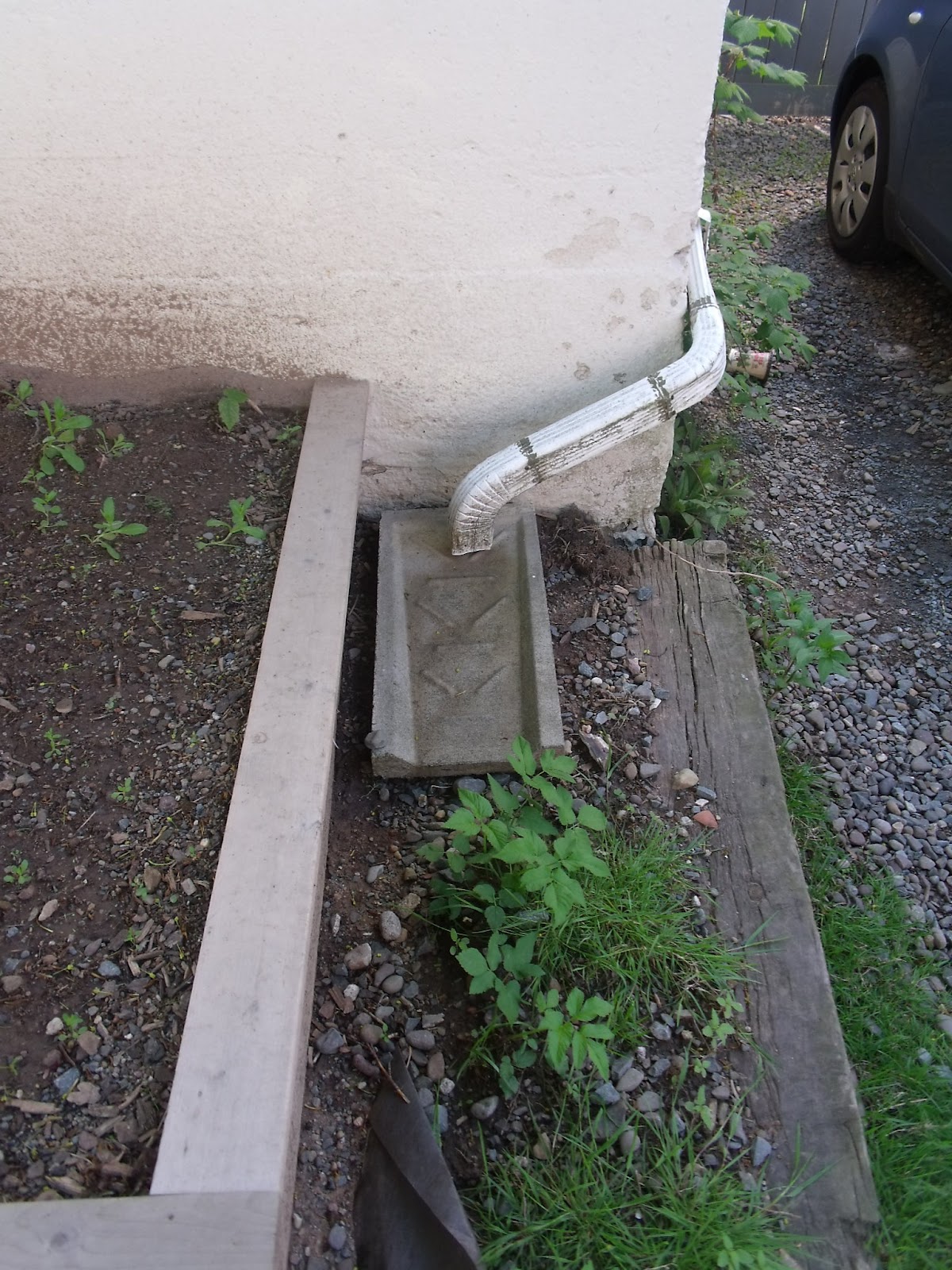
  • Disconnect your downspouts if they are directly connected to your home's sewer system. Place an extension on your downspouts to direct roof runoff at least 4 m away from your house so that water doesn't pool next to your basement. The extension can direct water toward a rain garden or backyard where it can soak into the ground without causing problems. Use a splash pad, pebbles or crushed rock to absorb the impact of water and prevent soil erosion. 
  • A French drain or bioswale can also be used to convey water away from your home. If you have a waterfront property and your runoff is being conveyed directly into a water body, try to add some curves or pooling areas to your conveyance system to slow down the water and allow sediment and other pollutants to settle out. 


Remember to disconnect your downspouts!


Extend your downspout so water drains away from  your house
Use a splash pad to prevent erosion
     2. Let runoff soak into the ground on your property
       

  •      Limit the amount of paved or other hard surfaces. Use permeable pavers, paved driveway strips or gravel for increased driveway permeability.
  •      Direct water toward a rain garden, which should be at least 4 m from your house. Rain gardens work great for everyday rain events, however it is important to consider designing an overflow system (swale or perforated pipe) to help convey excess water toward the street during a heavy rainfall event. 
  •      Soil aeration can reduce compaction and allow better infiltration. Water pooling on your property for an extended period is a good indication that your soil may need aeration.
 

If possible, reduce large paved areas
Modular paving stones, or permeable pavers, allow water to infiltrate into the ground
    3. Capture and reuse water

  •      Place a rain barrel under your disconnected downspouts to capture rooftop runoff. Elevate the barrel above ground level so that a tap or hose can be installed for easy water collection.


Raised rainbarrel system. Photo: The Transplanted Gardener
      Visit  the Canada Mortgage and Housing Corporation website for more practical information on how to improve drainage on your property to avoid basement flooding.