Showing posts with label bioswales. Show all posts

Friday, 20 September 2013

The Urban Stormwater and Aquifer Improvement Project

Great news!  This year, the EAC has launched a project in Porters Lake aiming to explore innovative stormwater management practices in new residential developments.  The project will involve collaborating with the local community and discussing water, stormwater management, and building healthy water neighbourhoods. We will share results from our pilot site, a new development that is implementing low impact development practices.  We will be monitoring groundwater levels and surface water quality around this new development as it is built and during ongoing construction.  This project is an exciting collaboration between an environmental organization, a developer, university and a community to explore how innovative stormwater management techniques can improve groundwater availability and surface water quality.  We are very proud to share this project with you.

(Photo: during a site visit the team stopped by Bell Lake- Jenny and Rob from the Centre for Water Resources Studies (CWRS), Kyle from genivar, Jocelyne from the Ecology Action Centre (EAC), Brad from Seven Lakes, Rick from CWRS, and Jennifer from the EAC).


Public Outreach


Our project is focused on the Porters Lake area, and we want to connect with this community on freshwater issues.  To share information on these topics, we will launch a series of talks in Lake Echo, Porters Lake, and Musqodoboit in fall 2013 and winter-spring of 2014.  Topics include "Healthy rainwater on your property", "How do we know a lake or stream is healthy?" and "Building a healthy water neighbourhood". Dates and locations for the fall talks are nearly confirmed, so stay tuned to this site so you can attend these events.  Stay tuned for more talks and events in the winter and spring of 2014!


Community Showcase


Bell Lake, in the community of Porters Lake
The EAC believes that seeing is believing, and we have the rain gardens, stormwater demonstration sites and living shorelines to prove it!  The EAC is keen to be working with a developer in the Halifax Regional Municipality using low impact development and open-space principles in their planning.  The Villages of Seven Lakes are in the beginning stages of development in the Porters Lake.  We encourage you to explore their website to find out about their design ideas which include 60% open space, clustered communities, rain gardens, bioswales, and infiltration areas for managing stormwater, innovative stormwater management systems, wetland restoration, tertiary wastewater treatment and many more interesting features.


Research

We are very fortunate to work with a developer that is keen to have ongoing monitoring of their development on lakes and groundwater near their sites.  We have partnered with the Dalhousie Centre for Water Resources Studies who will help us understand the natural conditions of lake and groundwater before homes and roads are built.  They will generate digital models of the site and the impact it has on the surrounding water systems.  These impacts will be compared to that of a conventional development using computer modeling.  This is the beginning of a long and beautiful relationship that will help us understand and hopefully promote low impact development practices elsewhere in HRM and Nova Scotia.

We would love to know your thoughts on stormwater in your community and on your property.  Consider taking our short survey to help us learn more!

Stay tuned for updates on this project, and for information on upcoming talks.

Friday, 25 May 2012

Drainage and your property

Proper drainage around your home will help reduce risk of basement flooding, reduce problems with your basement foundation (cracking, shifting), extend the life of your sump pump and reduce the volume of water that flows into the sewer system. The Canada Mortgage and Housing Corporation (CMHC) recommends 3 principles to improve water management on your property.


 1. Drain water away from your house and avoid causing drainage problems on neighbouring properties. 

  • Build up the ground around your house so that water flows away from your basement walls. CMHC recommends at least a 5% slope away from your foundation walls and a 2% slope for impermeable surfaces next to your house (driveway/patio).
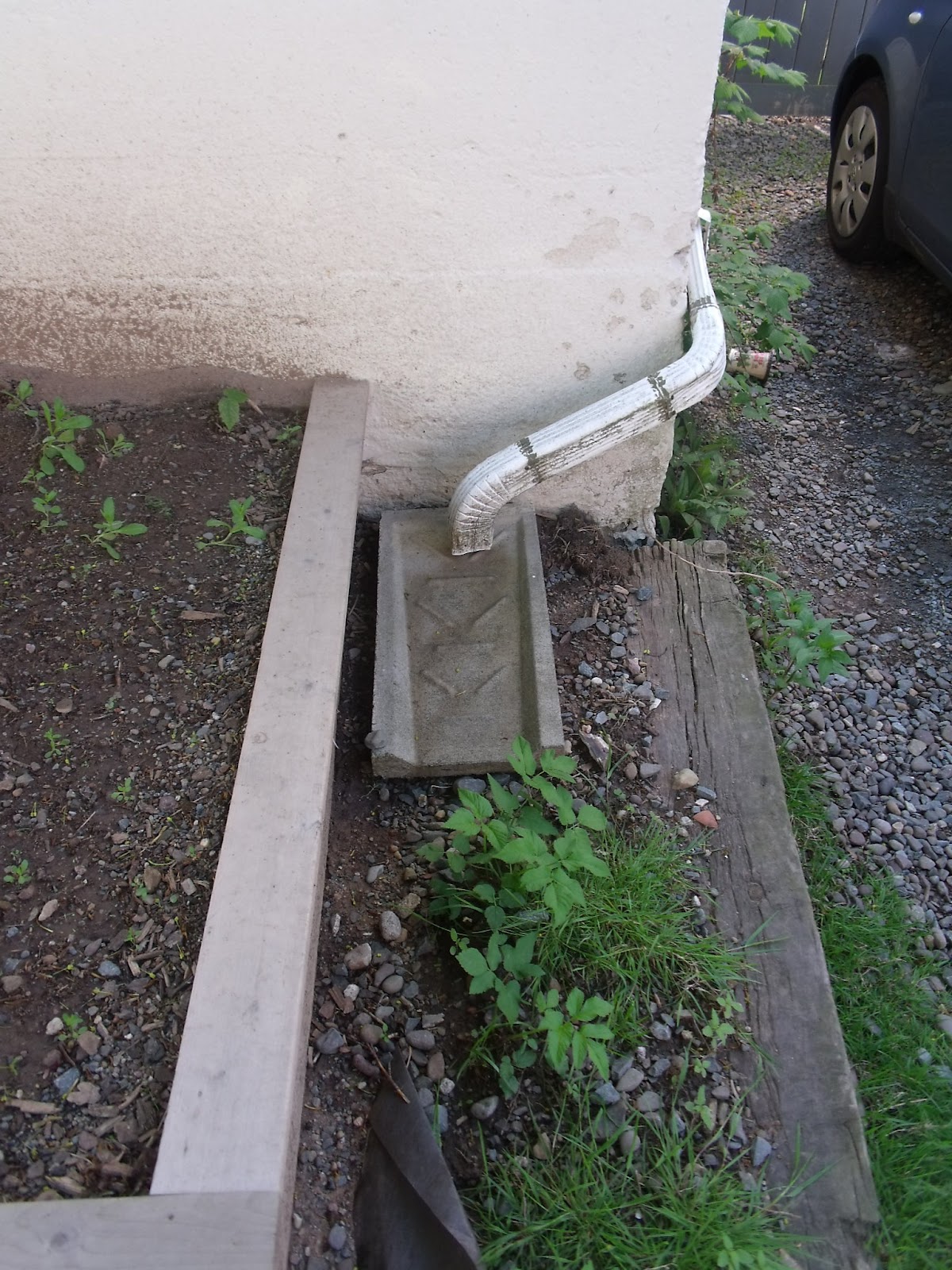
  • Disconnect your downspouts if they are directly connected to your home's sewer system. Place an extension on your downspouts to direct roof runoff at least 4 m away from your house so that water doesn't pool next to your basement. The extension can direct water toward a rain garden or backyard where it can soak into the ground without causing problems. Use a splash pad, pebbles or crushed rock to absorb the impact of water and prevent soil erosion. 
  • A French drain or bioswale can also be used to convey water away from your home. If you have a waterfront property and your runoff is being conveyed directly into a water body, try to add some curves or pooling areas to your conveyance system to slow down the water and allow sediment and other pollutants to settle out. 


Remember to disconnect your downspouts!


Extend your downspout so water drains away from  your house
Use a splash pad to prevent erosion
     2. Let runoff soak into the ground on your property
       

  •      Limit the amount of paved or other hard surfaces. Use permeable pavers, paved driveway strips or gravel for increased driveway permeability.
  •      Direct water toward a rain garden, which should be at least 4 m from your house. Rain gardens work great for everyday rain events, however it is important to consider designing an overflow system (swale or perforated pipe) to help convey excess water toward the street during a heavy rainfall event. 
  •      Soil aeration can reduce compaction and allow better infiltration. Water pooling on your property for an extended period is a good indication that your soil may need aeration.
 

If possible, reduce large paved areas
Modular paving stones, or permeable pavers, allow water to infiltrate into the ground
    3. Capture and reuse water

  •      Place a rain barrel under your disconnected downspouts to capture rooftop runoff. Elevate the barrel above ground level so that a tap or hose can be installed for easy water collection.


Raised rainbarrel system. Photo: The Transplanted Gardener
      Visit  the Canada Mortgage and Housing Corporation website for more practical information on how to improve drainage on your property to avoid basement flooding.

Friday, 16 December 2011

Bioswales


The Prospect Road Community Centre was built in 2010 with several stormwater features  incorporated into the building's design. Runoff from the roof is collected in a large underground cistern and reused in the building for non-potable uses such as flushing toilets.
Runoff from the site and parking lot are collected in bioswales, which are vegetated depressions where water collects and soaks into the ground. This filtration improves water quality by removing pollutants and allows for water to re-enter the ground, recharging groundwater supply.
Water enters the bioswale through curb openings
The bioswales are composed of an underground perforated pipe surrounded by 5 feet of rock and gravel. During an extreme precipitation event, high volumes of water flow overland into the bioswales, flooding the rock area and overflowing into the perforated pipe. The water is then collected and piped off-site, ultimately draining into a natural wetland adjacent to the building. 
 Bioswales reduce strain on built stormwater systems and reduce likelihood of flooding and infrastructure damage by passively allowing water to move off-site. This engineered system mimics how water would naturally flow in an unaltered environment. Bioswales are not only useful, but also can be an attractive landscape feature.
Water drains off-site into a natural wetland