Showing posts with label driveways. Show all posts

Thursday, 6 December 2012

Download our Stormwater Brochure

Want to plant the seed for alternative stormwater management with your friends, co-workers or members?  Download our colour brochure here and spread the word!


For a higher resolution version, please contact the Ecology Action Centre.


Friday, 25 May 2012

Drainage and your property

Proper drainage around your home will help reduce risk of basement flooding, reduce problems with your basement foundation (cracking, shifting), extend the life of your sump pump and reduce the volume of water that flows into the sewer system. The Canada Mortgage and Housing Corporation (CMHC) recommends 3 principles to improve water management on your property.


 1. Drain water away from your house and avoid causing drainage problems on neighbouring properties. 

  • Build up the ground around your house so that water flows away from your basement walls. CMHC recommends at least a 5% slope away from your foundation walls and a 2% slope for impermeable surfaces next to your house (driveway/patio).
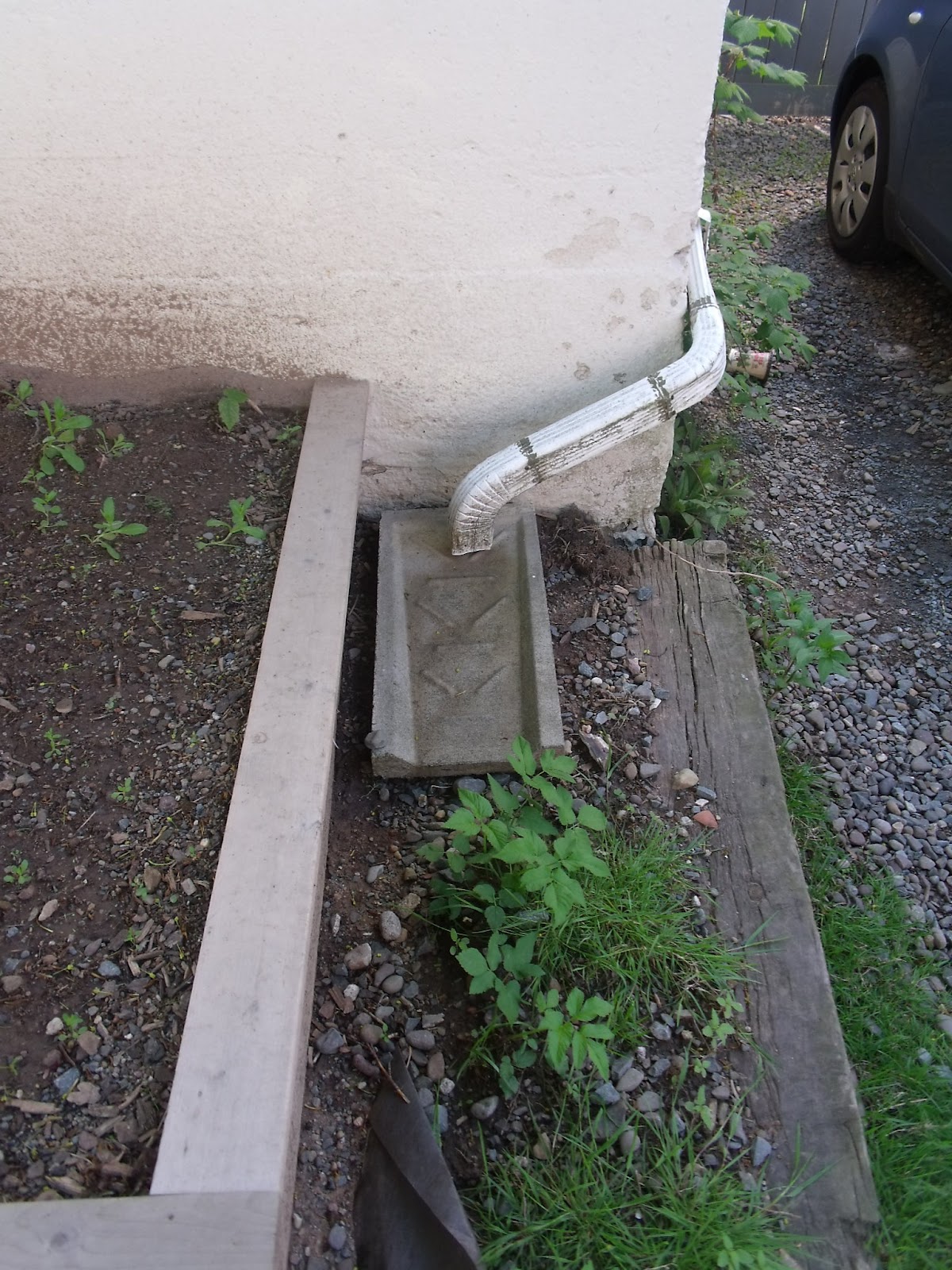
  • Disconnect your downspouts if they are directly connected to your home's sewer system. Place an extension on your downspouts to direct roof runoff at least 4 m away from your house so that water doesn't pool next to your basement. The extension can direct water toward a rain garden or backyard where it can soak into the ground without causing problems. Use a splash pad, pebbles or crushed rock to absorb the impact of water and prevent soil erosion. 
  • A French drain or bioswale can also be used to convey water away from your home. If you have a waterfront property and your runoff is being conveyed directly into a water body, try to add some curves or pooling areas to your conveyance system to slow down the water and allow sediment and other pollutants to settle out. 


Remember to disconnect your downspouts!


Extend your downspout so water drains away from  your house
Use a splash pad to prevent erosion
     2. Let runoff soak into the ground on your property
       

  •      Limit the amount of paved or other hard surfaces. Use permeable pavers, paved driveway strips or gravel for increased driveway permeability.
  •      Direct water toward a rain garden, which should be at least 4 m from your house. Rain gardens work great for everyday rain events, however it is important to consider designing an overflow system (swale or perforated pipe) to help convey excess water toward the street during a heavy rainfall event. 
  •      Soil aeration can reduce compaction and allow better infiltration. Water pooling on your property for an extended period is a good indication that your soil may need aeration.
 

If possible, reduce large paved areas
Modular paving stones, or permeable pavers, allow water to infiltrate into the ground
    3. Capture and reuse water

  •      Place a rain barrel under your disconnected downspouts to capture rooftop runoff. Elevate the barrel above ground level so that a tap or hose can be installed for easy water collection.


Raised rainbarrel system. Photo: The Transplanted Gardener
      Visit  the Canada Mortgage and Housing Corporation website for more practical information on how to improve drainage on your property to avoid basement flooding.

Monday, 23 January 2012

Permeable Pavement

Permeable pavement allows precipitation to slowly soak into the ground, thereby reducing runoff from driveways, roads and parking lots. There are two main types of permeable pavement – permeable pavers (also known as interlocking concrete blocks) and porous pavement. These BMPs can be incorporated into designs for new developments, or used as a retrofit option for existing homes and buildings. 

Permeable Pavers consist of impervious concrete blocks or tiles that allow water to infiltrate between blocks in voids filled with gravel or grass.  

Permeable Paver (photo: bit.ly/be1x3a)
Parking space at the Ecology Action Centre

Porous Asphalt or Concrete consists of standard asphalt or concrete mixes with the finer aggregates removed resulting in pores within the pavement that allows water to permeate through the surface. 

A parking lot on the Dalhousie University campus uses porous pavement  to reduce stormwater runoff. The lot was graded allowing runoff to flow towards the strip porous pavement area at one end of the lot. There is a clear stone base under the permeable area with a perforated PVC pipe leading to catch basin in the corner of the lot.  Water that infiltrates through the pavement has a chance to soak into the ground before being picked up by the perforated pipe. A strip of permeable pavement on a graded lot works well, therefore repaving the entire parking lot is not necessary. Some concern exists about how porous pavements can withstand Nova Scotia's harsh winter conditions, however this was put in during the Fall of 2010, and there has been no damage reported to date.


Strip on porous pavement on a Dalhousie University parking lot (width of the car)
Regular asphalt on the left, porous pavement on the right
The City of Vancouver is using an alternative approach to reduce imperviousness on residential side streets called ‘Country Lane Treatment’. This design incorporates a soil and grass covered plastic mat between two parallel concrete driving strips. Permeable pavers were used to connect driveways to the driving strips. Click here to see more examples of road treatments from Vancouver. 


'Country Lane' in Vancouver (Photos: http://bit.ly/A4s9Os)
More information on permeable pavements and other stormwater management technologies can be found on the Sustainable Technologies Evaluation Program (STEP) website, an initiative led by the Toronto and Region Conservation Authority.