Showing posts with label infiltration. Show all posts

Wednesday, 16 October 2013

Dalhousie Rain Garden is Complete!


There’s a new rain garden in town! With funding from TD Friends of the Environment, the Coastal and Water Team at the EAC was able to partner with Dalhousie’s Office of Sustainability to build a rain garden on the Dalhousie Campus.  Our site is a challenging one, in that it receives high flows of stormwater during heavy rains, enough to cause basement flooding of several buildings down the hill toward the Northwest Arm. The garden is located at the intersection of Coburg Rd and Oxford Rd, at the School of Social Work ‘house-turned-office’.  While our goal was initially to build a rain garden that demonstrates that this is an accessible DIY project for homeowners, this site and the design it required moved the project out of the DIY category!  However, there are many aspects of the design and build process that still apply to a homeowner excited about a rain garden sized for capturing rainwater from a roof via a downspout or two.

Our Process & Design
First, we assessed the site, which means that we looked at a variety of factors that will influence how water moves over the site. This includes soil type and drainage properties, slope, and the size of the rain catchment area. Check out previous rain garden how-to posts here for details on these steps.

Our calculations showed that we needed a very large garden to absorb all the stormwater which we calculated flowed onto the site. In fact, the calculated area was larger than the area we had available! In addition, we found the slope of the site to be steeper than the suggested 12% for rain gardens in even the flattest area. This meant that we had to increase the capacity of the garden not by surface area, but by depth. The garden is 24 inches deep, whereas most rain gardens are 6-8 inches deep. To increase the porous volume in the garden, we filled the depression to a depth of 14 inches of clear stone, which would hold water in the bottom of the garden, while also holding soil on top. The cross-sectional design looked much like this diagram, from the Fairfax County Virginia website (Figure 1).
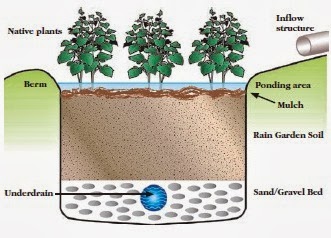
Figure 1. Approximate cross-sectional view of the rain garden at Dalhousie.

We used drainage tile (underdrain in the diagram) to move the stormwater that flows from the road and sidewalk over the steep hillside into the rain garden. See the photo below (Figure 2).


Figure 2. In the middle of this photo, the drainage tile is sticking out of the clear stone in the middle of the garden. The tile extends back to where the volunteers are sitting on the slope to catch water flowing down the slope and direct it into the rain garden.

In this photo (Figure 2) you can see how deep the garden is and just how much clear stone is at the bottom. And another key design feature is starting to form: the berm! The berm is essential in a garden of this size, on this slope, and so close to the house. The berm will help retain the water in the garden while it pools and infiltrates. Below (Figure 3) you can see how the berm has been planted with larger native shrubs such as sweet fern and bayberry, as well as a serviceberry tree. As these plants establish, they will help anchor the berm in place. To increase the strength of the berm, it was constructed out of sod mats from the beginning of excavation. Each layer was tamped down, and then new sod was staked into the backside of the berm all the way around the edge of the garden.

Figure 3. The depth of the garden, the volume of clear stone and the berm are all clear in this photo.

Another unique feature of the garden can be seen from the photo (Figure 4) of the completed garden below: the centre of the garden is actually filled with clear stone and then beach stone all the way to the surface. The goal of this design is to allow water which rushes down the slope from Coburg Rd to first hit the beach stone, which will slow down the flow. Then it will make its way to this holding pond in the centre, and as that space fills, the water will first infiltrate horizontally into the soil and plant roots, and then only when it is really full will the water flow over the surface of the mulch and soil, up to the height of the berm. The water will be slowed to the point where it can infiltrate into the groundwater.


Figure 4. The back portion of the completed garden contains stone all the way to the surface, with native shrubs planted in the berm.

Stay tuned to the blog over the coming weeks to learn more about the plants we used and how we chose them, as well as thoughts about rain gardens functioning as marine protective areas, coastal erosion prevention tools, and social activities.

Thursday, 6 December 2012

Download our Stormwater Brochure

Want to plant the seed for alternative stormwater management with your friends, co-workers or members?  Download our colour brochure here and spread the word!


For a higher resolution version, please contact the Ecology Action Centre.


Friday, 25 May 2012

Drainage and your property

Proper drainage around your home will help reduce risk of basement flooding, reduce problems with your basement foundation (cracking, shifting), extend the life of your sump pump and reduce the volume of water that flows into the sewer system. The Canada Mortgage and Housing Corporation (CMHC) recommends 3 principles to improve water management on your property.


 1. Drain water away from your house and avoid causing drainage problems on neighbouring properties. 

  • Build up the ground around your house so that water flows away from your basement walls. CMHC recommends at least a 5% slope away from your foundation walls and a 2% slope for impermeable surfaces next to your house (driveway/patio).
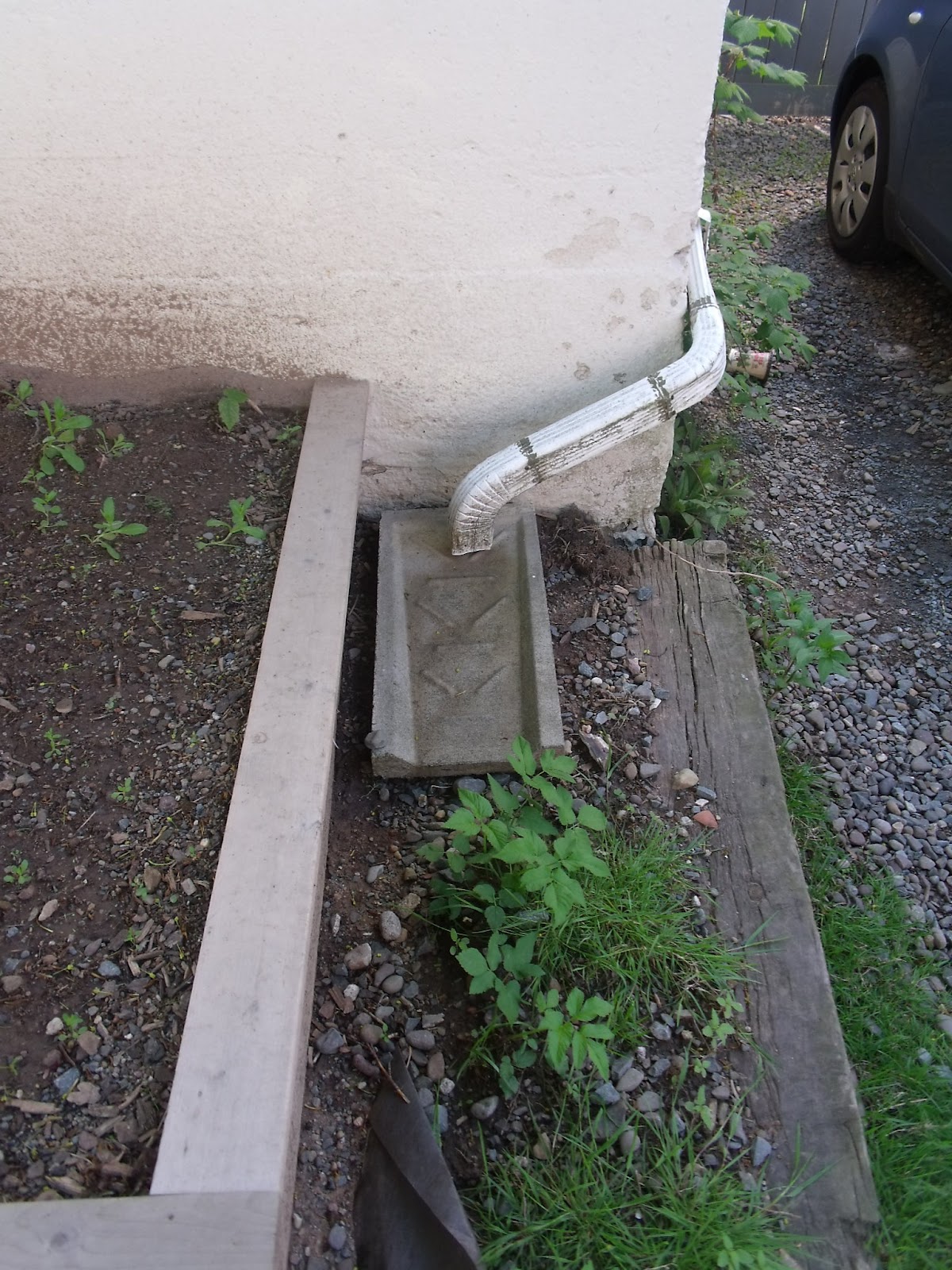
  • Disconnect your downspouts if they are directly connected to your home's sewer system. Place an extension on your downspouts to direct roof runoff at least 4 m away from your house so that water doesn't pool next to your basement. The extension can direct water toward a rain garden or backyard where it can soak into the ground without causing problems. Use a splash pad, pebbles or crushed rock to absorb the impact of water and prevent soil erosion. 
  • A French drain or bioswale can also be used to convey water away from your home. If you have a waterfront property and your runoff is being conveyed directly into a water body, try to add some curves or pooling areas to your conveyance system to slow down the water and allow sediment and other pollutants to settle out. 


Remember to disconnect your downspouts!


Extend your downspout so water drains away from  your house
Use a splash pad to prevent erosion
     2. Let runoff soak into the ground on your property
       

  •      Limit the amount of paved or other hard surfaces. Use permeable pavers, paved driveway strips or gravel for increased driveway permeability.
  •      Direct water toward a rain garden, which should be at least 4 m from your house. Rain gardens work great for everyday rain events, however it is important to consider designing an overflow system (swale or perforated pipe) to help convey excess water toward the street during a heavy rainfall event. 
  •      Soil aeration can reduce compaction and allow better infiltration. Water pooling on your property for an extended period is a good indication that your soil may need aeration.
 

If possible, reduce large paved areas
Modular paving stones, or permeable pavers, allow water to infiltrate into the ground
    3. Capture and reuse water

  •      Place a rain barrel under your disconnected downspouts to capture rooftop runoff. Elevate the barrel above ground level so that a tap or hose can be installed for easy water collection.


Raised rainbarrel system. Photo: The Transplanted Gardener
      Visit  the Canada Mortgage and Housing Corporation website for more practical information on how to improve drainage on your property to avoid basement flooding.

Wednesday, 25 April 2012

Urban Forests

What is a simple action that homeowners can take to reduce stormwater runoff leaving their property? Plant a tree.
h
 Trees and forests benefit air quality, biodiversity, neighbourhood aesthetics and also play an essential role in managing stormwaterTree canopies reduce stormwater runoff by intercepting, capturing and storing rainfall and releasing water into the atmosphere through evapotranspiration. In urban and suburban settings, a single deciduous tree can intercept between 500-760 gallons (~1,800-2,800 L) per year, while a mature coniferous tree can intercept over 4,000 gallons (~15,000 L) per year (PA Trees). In addition, tree roots and leaf little help promote infiltration of runoff into the soil.


Source: http://bit.ly/IcxK5H
Trees also act as filters, taking up nutrients and contaminants from the ground that may otherwise directly enter natural water bodies, or end up in wastewater treatment plants. As we begin to remove forest canopy and replace it with lawns and impervious surfaces, we immediately have an impact on quality and quantity of stormwater runoff. 
h
Urban Forests in Halifax Regional Municipality             
                                                               
In HRM, it is estimated that street trees provide about $2.1 million in stormwater reduction services annually (HRM). HRM is currently developing an Urban Forest Master Plan (UFMP) with the goal of ensuring a sustainable future for our urban forest. The plan contains an overview of the issues and opportunities regarding sustainable urban forest management in HRM. Neighbourhood Factsheets have also been developed that describe the species composition and age distribution of trees found in each neighbourhood, as well as targets for urban forest restoration. Take a look at the draft UFMP and Neighbourhood Factsheets here

Tuesday, 6 December 2011

Stormwater Infiltration and Inflow


In HRM, there are two types of wastewater collection systems. Separated wastewater systems are designed to carry wastewater only. In older areas of Halifax and Dartmouth, combined systems exist that accept both wastewater and stormwater. When stormwater unnecessarily enters the wastewater system, the excess water load can cause a range of problems.


Stormwater can enter the wastewater system in two ways:
Infiltration (groundwater entering through cracks and leaks in the wastewater pipes) or Inflow (stormwater entering the system through a direct connection like sump pumps, drains or catchbasins).  Stormwater that enters the wastewater system ends up being collected and treated unnecessarily, which causes extra strain on  treatment plants and can lead to  combine sewer overflows (CSO) in heavy rains. CSOs cause untreated wastewater to overflow directly into natural water bodies leading to environmental and health risks. Infiltration and inflow can also cause sewer backups in people’s homes and can add to operating costs of treatment facilities which ultimately leads to higher rates for customer.  To address this serious issue, stormwater needs to be better managed at the source, by retaining runoff (allowing it to soak into the ground, or be collected and reused) on-site instead of allowing it to enter the wastewater system.

To reduce the frequency and magnitude of infiltration and inflow events,  Halifax Water has designed a Stormwater Inflow Reduction (SIR) Program to help customers indentify ways to better manage stormwater on their properties. The number one tip for property owners? Disconnect your downspout if it is directly connected to the wastewater system. This water can be redirected onto your lawn and collected in a rain garden or rain barrel, or allowed to directly soak into the ground.


If you have concerns about where your water is going, you can call 490-RAIN (7246) to have a free inspection of your property. Click here to find out more.