Showing posts with label adaptation. Show all posts

Wednesday, 16 October 2013

Dalhousie Rain Garden is Complete!


There’s a new rain garden in town! With funding from TD Friends of the Environment, the Coastal and Water Team at the EAC was able to partner with Dalhousie’s Office of Sustainability to build a rain garden on the Dalhousie Campus.  Our site is a challenging one, in that it receives high flows of stormwater during heavy rains, enough to cause basement flooding of several buildings down the hill toward the Northwest Arm. The garden is located at the intersection of Coburg Rd and Oxford Rd, at the School of Social Work ‘house-turned-office’.  While our goal was initially to build a rain garden that demonstrates that this is an accessible DIY project for homeowners, this site and the design it required moved the project out of the DIY category!  However, there are many aspects of the design and build process that still apply to a homeowner excited about a rain garden sized for capturing rainwater from a roof via a downspout or two.

Our Process & Design
First, we assessed the site, which means that we looked at a variety of factors that will influence how water moves over the site. This includes soil type and drainage properties, slope, and the size of the rain catchment area. Check out previous rain garden how-to posts here for details on these steps.

Our calculations showed that we needed a very large garden to absorb all the stormwater which we calculated flowed onto the site. In fact, the calculated area was larger than the area we had available! In addition, we found the slope of the site to be steeper than the suggested 12% for rain gardens in even the flattest area. This meant that we had to increase the capacity of the garden not by surface area, but by depth. The garden is 24 inches deep, whereas most rain gardens are 6-8 inches deep. To increase the porous volume in the garden, we filled the depression to a depth of 14 inches of clear stone, which would hold water in the bottom of the garden, while also holding soil on top. The cross-sectional design looked much like this diagram, from the Fairfax County Virginia website (Figure 1).
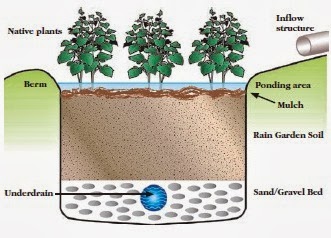
Figure 1. Approximate cross-sectional view of the rain garden at Dalhousie.

We used drainage tile (underdrain in the diagram) to move the stormwater that flows from the road and sidewalk over the steep hillside into the rain garden. See the photo below (Figure 2).


Figure 2. In the middle of this photo, the drainage tile is sticking out of the clear stone in the middle of the garden. The tile extends back to where the volunteers are sitting on the slope to catch water flowing down the slope and direct it into the rain garden.

In this photo (Figure 2) you can see how deep the garden is and just how much clear stone is at the bottom. And another key design feature is starting to form: the berm! The berm is essential in a garden of this size, on this slope, and so close to the house. The berm will help retain the water in the garden while it pools and infiltrates. Below (Figure 3) you can see how the berm has been planted with larger native shrubs such as sweet fern and bayberry, as well as a serviceberry tree. As these plants establish, they will help anchor the berm in place. To increase the strength of the berm, it was constructed out of sod mats from the beginning of excavation. Each layer was tamped down, and then new sod was staked into the backside of the berm all the way around the edge of the garden.

Figure 3. The depth of the garden, the volume of clear stone and the berm are all clear in this photo.

Another unique feature of the garden can be seen from the photo (Figure 4) of the completed garden below: the centre of the garden is actually filled with clear stone and then beach stone all the way to the surface. The goal of this design is to allow water which rushes down the slope from Coburg Rd to first hit the beach stone, which will slow down the flow. Then it will make its way to this holding pond in the centre, and as that space fills, the water will first infiltrate horizontally into the soil and plant roots, and then only when it is really full will the water flow over the surface of the mulch and soil, up to the height of the berm. The water will be slowed to the point where it can infiltrate into the groundwater.


Figure 4. The back portion of the completed garden contains stone all the way to the surface, with native shrubs planted in the berm.

Stay tuned to the blog over the coming weeks to learn more about the plants we used and how we chose them, as well as thoughts about rain gardens functioning as marine protective areas, coastal erosion prevention tools, and social activities.

Thursday, 6 December 2012

Download our Stormwater Brochure

Want to plant the seed for alternative stormwater management with your friends, co-workers or members?  Download our colour brochure here and spread the word!


For a higher resolution version, please contact the Ecology Action Centre.


Sunday, 4 November 2012

Stormwater and climate change adaptation


Climate change is expected to bring about more extreme weather events such as rain, snow, drought, heat waves and severe storms. The massive damage caused by Hurricane Sandy is a reminder that extreme weather is now a reality. Stormwater systems will be affected by the increased frequency and intensity of rainfall events. The higher volume of rainfall may exceed the capacity of stormwater entry points or cause sewer overflows, leading to infrastructure damage and impacting water quality. Stormwater systems may need to be upgraded to deal with the increased flow. There is an urgent need to understand and adapt to the many climatic changes that are expected to occur. Innovative stormwater management practices are an important part of climate change adaptation.

A recent report published by climate scientist, Dr. Gordon McBean, examines how weather patterns in Canada have changed in the past and how they are expected to change in the future. The report aims to provide decision makers with the information they need to better adapt public and private infrastructure to the realities of the changing climate. In the report, Dr. McBean states, “Both the historical and projected trends shown in the research point to the need for Canada to adapt now in order to minimize social and economic costs in the future.” Predictions made for Atlantic Canada in the report include a likely increase in hurricane and storm activity in the region with resulting storm surges. Freezing rain events will likely increase by 50 per cent in Newfoundland. Nova Scotia could see increases of about 20 per cent.

These extreme weather events have had already had huge environmental and economic impacts in Canada. In 2011, catastrophic events cost Canadian insurers roughly $1.7B and almost $1B in each of the two previous years. The majority of these insured losses were caused by extreme weather events, but smaller weather events also played a role in significant property damage for consumers (IBC). 

Climate change impacts all of us and we all have an important role in reducing the potential impacts of stormwater. Source control involves managing runoff on individual lots and relies on property owners and developers to implement practices to reduce the amount of runoff leaving a site. Installing a rain barrel, creating a rain garden, retaining green space and not using pesticides are a few small practices that will protect your home, increase the resiliency of our stormwater systems and improve our ability to adapt to climate change.

Monday, 23 July 2012

Urban Water and your Property


The following blog post was written by Mike Price, former general manager of Toronto Water and highly valued Ecology Action Centre volunteer. This  post provides a comprehensive overview on the issues and solutions related to incoming water on a property. A subsequent post will look at outgoing water, or drainage. Thanks for the great blog contribution, Mike! 


Downspout deco-chain (Photo: M. Price)
The water used on a typical urban lot comes from two directions. Down from the sky or out of a water pipe. Rainfall can be good, and sometimes hazardous, but we don’t make the best use of it. The water from your tap (potable) can be from several sources:
        - Private untreated supply from a well on the property
        - Municipal treated supply, from the tap, originates from surface water (lake or river) or ground water from wells

·        Current Issues regarding municipal water supplies

      -  Surface waters, lakes and rivers, can become contaminated from human activities. 
      -  The volume of supply from surface water in Canada is dwindling due in part to ‘climate change’, but also due to increased demand. 
      -  Ground water supplies are similarly impacted but depending on the depth of the well the ability to replenish is being negatively impacted by human intervention.
      -   A large amount of energy is used to treat and pump the municipal water to reservoirs and around the water distribution system. 
      -  During hot summer months up to 50% of the water supplied is used for external ground watering.
       - Throughout the year about 60% of the building water use is for flushing toilets

Recreational beach closure (Photo: M.Price)

. Current solutions for urban water providers and users


    Water providers (Province, Municipalities and/or water utilities)

  -   Prepare and implement Source Water Protection Plans
  -   Prepare and promote Water Efficiency Plans
  -   Actively seek out and repair water pipe leaks
  -   Eliminate unnecessary fire hydrant flushing
  -   Minimize energy used in the treatment and distribution of potable water
  -   Prepare and regulate Pollution Prevention Plans
  -   Prepare and implement Storm Water Management Plans
   -  Mitigate the impacts of Combined Sewer Overflows

   Water users (residential and ICI property owners)

 -  Minimize tap water use
     a)   Low flush toilets
     b)   Reduced volume shower and tap heads
     c)   Grey water re-use (for toilet flushing)
    d)   Use more drought resistant garden plants (called Xeriscaping)
    e)   Eco-gardening
     f)   Use timers on automatic sprinklers

 - Maximize rain water use
     a)   Rainwater harvesting
               1.   Downspout disconnection
               2.   Grade property to keep rainwater from running off the property
               3.   Use rain barrels for garden watering
               4.   Create specific areas for a rain garden
               5.   Minimize paved areas
Rain barrel installed at disconnected downspout  (Photo: M. Price)

Thursday, 12 July 2012

Pain in the Drain

 This article was written by Heather Hunter and published in the Summer 2012 edition of 'Between the Issues', the Ecology Action Centre's quarterly publication. Thanks for covering this important topic, Heather. The full BTI can be downloaded here.


The last time you were caught in a downpour, jumping over sidewalk rivulets and trying not to get splashed by passing cars, perhaps your thoughts didn’t automatically jump to where does all this water go? What contaminants might be in it?  But stormwater, the rainwater and melted snow that runs off roads, lawns, roofs and other hard surfaces, is an area where some real environmental action is needed. Storm water often contains motor oil, gasoline, sediment, fertilizer and other contaminants which damage natural aquatic habitats.  Without proper stormwater management practices, serious environmental and economic consequences can occur such as erosion and loss of habitat.

Cameron Deacoff, an Environmental Performance Officer with the Halifax Regional Municipality, took some time to explain why we should be giving this issue some major consideration and steps that we can take at individual and municipal levels to improve our storm water management practices.

Why you should care about storm water management
On earth there is a finite amount of water.  Fortunately, water is efficiently conserved through the hydrological cycle – including the processes of evaporation, transpiration, condensation, precipitation, surface runoff & percolation. This natural water cycle is disrupted by human intervention.  In urban landscapes in particular, impervious surfaces such as roofs, roads and parking lots render the land unable to absorb water. Instead, stormwater runs over streets and sidewalks and along the way becomes polluted with oil, garbage, fertilizers, pesticides and other contaminants.  In fact, studies have shown that storm water conveys up to 600 pollutants, many of which may be harmful to both humans and the environment.  Unlike sewage wastewater, stormwater is often not treated before it enters our waterways.

While good stormwater management has always been important, it is now being seen as more of a “hot button” issue as people are gaining a better understanding of the impact on environments, including erosion, removal or destruction of fish and wildlife habitat, and pollution causing direct damage to fish and other aquatic organisms.  We are understanding that stormwater needs to be managed - efforts should be made to reduce contaminants in street run-off, and there should be some treatment before stormwater joins up with natural waterways.  In addition, there is an understanding that we should avoid directing stormwater into wastewater systems (i.e. sewers that handle wastewater from toilets, tubs, laundry etc) because wastewater systems are not designed to treat stormwater flows. During heavy rainfall events, treatment processes can fail as throughput exceeds the capacity of treatment facilities, resulting in untreated overflows. Other risks associated with poor stormwater management include flooding, basement backups, and associated property and financial losses.

The importance of stormwater management is not going to decline any time soon.  Cameron explains that aging infrastructure is making the issue more serious today. “Much of the infrastructure in the ground was put there several decades ago,” he says, “and maintenance and replacement needs are ramping up”. He adds that “climate change is also having an impact on the issue, because our weather patterns are changing, resulting in increasing volumes of precipitation, and increasing intensity of rainfall events. Winters have been milder, resulting in less storage of precipitation as snow and ice, making for shifting hydrological patterns for which stormwater management systems were neither designed nor constructed.”

What you can do
To enhance your individual stormwater management practices, Cameron provided the following tips:
  • Retain as much natural land cover on your property as possible (i.e., do not cover the ground with asphalt, concrete, etc. unless necessary).
  • Disconnect your downspouts (eaves troughs, foundation drains, sump pumps, etc.) from your house onto the surface of your property for drainage into the ground; or at least ensure that they are not connected to the wastewater sewer system.
  • Store and manage waste materials properly so that they do not flow into storm sewers, swales, etc., during a storm. This includes covering dirt piles, removing litter and pet waste.
  • Landscape your property with plants and other materials that are native to where you live. These have fewer needs for fertilizers and pesticides, which should be used sparingly if at all.
  • Support fees for storm water management. These services benefit you and the environment.

At a municipal policy level, there are many steps that cities and towns in NS can be taking to improve stormwater management practices.  Some recommendations include:
  • Having your town or city conduct a review of water-related issues within their jurisdictions, and those shared with neighbouring municipalities.
  • Ensuring that municipal urban design & planning jointly consider water quality and water quantity along with land use and transportation.
  • Devote some attention to retrofitting issues in older urban areas, not all towards improving development practices in new "greenfield" areas.
Some municipalities such as the City of Cambridge in Massachusetts and Victoria BC have begun implementing progressive by-laws to counter stormwater pollution.  In Cambridge, significant investments in catch basin cleaning, street sweeping, and urban forestry programs have been made.   

In Victoria, bylaws have been passed for businesses as well as construction and development sites. Businesses must be fitted with a “Storm Water Rehabilitation Unit”, which is a generic term for any system designed to remove targeted contaminants. In general, any system that removes solids such as gravel, sand and silt, and floating materials like oils and trash should be adequate. At construction sites, regulations prevent construction waste water from being directly joined to drainage systems or sewer systems, hazardous wastes are tightly controlled with spill plans in place, and after construction has finished the site must be cleaned up to prevent excess gravel, dirt and pollutants from entering natural waterways.

Stormwater management practices may vary across municipalities, and depending on existing infrastructure, different levels of investment may be required. However, the first step is to raise our level of awareness about this issue.   To reduce harm to our natural waterways, and our overall ecological footprint, stormwater management must become a permanent part of our “environmental consciousness”.

Thursday, 22 March 2012

Engineered Wetlands

Appleton-Middleton Engineered Wetland Photo: www.abydoz.com
When the aging sewage treatment plants needed upgrades in the towns of Appleton and Glenwood in Newfoundland and Labrador, they took an innovative approach to improving stormwater and sewage treatment by implementing an engineered wetland. The towns were concerned  the quality of discharge that was entering the Gander River which was not meeting Provincial or Federal standards and about the increasing maintenance costs required by the older systems.


The newly constructed engineered wetland provides secondary treatment of wastewater, is cost-effective and has greatly improved the water quality discharged into the Gander River. This project was the Atlantic winner of the Watershed Awards, which recognizes community climate change adaptation efforts and is awarded by Insurance Bureau of Canada and the Federation of Canadian Municipalities. Check out this great video to see how the engineered wetland works. Video provided by the Insurance Bureau of Canada.