Friday, 6 July 2012

Lawn care and stormwater pollution

Photo: www.inharmony.com

Pesticides and fertilizers are among the many common pollutants found in stormwater runoff that can impact water quality. When pesticides wash into local waters they contaminate the water and poison aquatic life. Fertilizers contain nutrients such as phosphorus and nitrogen. These nutrients can overload natural water bodies and result in the growth of algal blooms which use up the water's oxygen and impact fish and other aquatic organisms. 

To protect water quality of lakes, rivers and streams it is strongly recommended that property owners reduce or eliminate the use of cosmetic pesticides and fertilizers. You can still have a healthy, happy lawn without the use of chemicals. Here are some tips to protect your lawn and the surrounding environment:
  •  Vinegar is one of the most easily accessible and safest ways to kill weeds. The acetic acid in vinegar breaks down plant cells and kills the top growth.  But, because it does not kill the roots, you’ll have to reapply.   
  • Corn gluten meal, found at lawn and garden centres, acts as both a fertilizer and an all-natural herbicide that is effective at preventing the growth of dandelions and other weeds.  It can be applied to an established lawn in early spring before the weeds germinate.

  • Kitchen compost and lawn waste make excellent natural fertilizer for your lawn. Or better yet, brew your own compost tea!

  • Mow high (6-7 cm) and leave grass clippings on the lawn, which adds nutrients to the soil. The shade of tall, dense grass will overcrowd weeds and reduce growth.
  • Aeration is the best fertilizer. Use an aerator to pull plugs of grass out of your lawn to allow more air to reach the roots. This promotes a healthy lawn and results in vigorous new growth.
  •  Landscape with native species that will have less need for fertilizers and pesticides.
  • Also, remember to pick up after your pets. Pet waste carries numerous bacteria which finds its way into the storm sewer system and ultimately into streams, rivers and lakes.

Wednesday, 20 June 2012

Thermal pollution

When we think of how stormwater impacts lakes, rivers and streams, we tend to think of sediment and other contaminants that degrade water quality. We rarely think of how elevated runoff temperatures, known as thermal pollution, can greatly alter the temperature regime of natural water bodies. On hot days, impervious surfaces, such as parking lots and roofs, absorb and emit heat.  When it rains, heated runoff that flows over these surfaces can potentially increase the temperature of receiving waters. Increased temperatures can negatively impact coldwater fish populations by interfering with spawning and migration patterns, decreasing dissolved oxygen levels and even resulting in fish kills.

Stormwater Best Management Practices have an effect on runoff temperature, and the University of New Hampshire's Stormwater Centre has been researching the effectiveness of various BMPs in regulating thermal pollution from stormwater runoff.

They found that surface systems, such as retention ponds, that are exposed to direct sunlight provide little no reduction of high runoff temperatures and can potentially increase already elevated summer runoff temperatures. Various infiltration and filtration systems were best able to moderate runoff temperatures by thermal exchange with cooler subsurface materials. Systems with a large subsurface area had the greatest ability to buffer runoff temperatures. The full report titled 'Examination of Thermal Impacts from Stormwater Best Management Practices' can be found here. 

Brook Trout. (Photo: Source)

Tuesday, 12 June 2012

Pioneer Park Stormwater Management Project


The Town of Richmond Hill, Ontario, created a stormwater management park to collect and treat runoff as well as provide flood and erosion protection to neighbouring communities. Originally built in the 1980's, Pioneer Park treated runoff from 26 ha of residential development. Redesigned in 2009/2010, the improved stormwater management park now provides water quality and quantity services to a 740 ha catchment area.

The park consists of a wet pond to treat runoff from everyday rain events, a dry pond to collect and treat runoff from major, intense rainfall events, an oil grit separator for pre-treatment and a channel for fish passage. This project was a 2010 winner of Insurance Bureau of Canada's Watershed Awards.

gallery_image_128.jpg
The completed stormwater management park. Photo: www.rmconstruction.ca
gallery_image_130.jpg
Under construction in 2010. Photo: www.rmconstruction.ca
Check out this great video to learn more about how Pioneer Park was created and the many environmental and economic benefits it provides to the Town of Richmond Hill. This video was provided by Insurance Bureau of Canada.

Thursday, 7 June 2012

Backwater valves


Basement flooding can be caused by a number of reasons including cracks or leaks in basement walls, blocked pipes, failure of foundation drains (weeping tiles) and poor lot drainage. Heavy rain events can also overload city sewer systems and lead to sewage backing up through house sewer lines and flowing into unprotected basements. Damage from sewer backups is costly for homeowners and municipalities. The Canadian insurance industry pays an estimated $1.7 billion each year in claims due to water damage. 

A backwater valve is a flood-proofing device that prevents sewage in an overloaded public sewer system from backing up into your basement. This fixture, placed on a sewer line in your basement, works as a one way system - sewage can go out, but not back in. The backwater valve automatically closes if sewage backs up from the main sewer line. You should contact a licensed plumber to install a mainline backwater valve and to obtain the proper plumbing permits.

Backwater valve (source: plumber-master.com)
 
Since decades ago, the National Plumbing Code has required the installation of a backwater valve. In HRM, construction or renovation projects have been required to follow the National Plumbing Code including the installation of backwater valves. This became more closely monitored after HRM amalgamation in 1996, when all of HRM required inspections with the issuance of a permit for construction or renovation projects.

Today you are required to get a construction permit (and inspection) for any renovation or construction exceeding $5,000 or when performing structural work. This would include adding or altering a connection to the storm or ssystem such as installing a backwater valve (the only exemption is when replaceing a plumbing fixture).

For more tips on reducing the risk of basement flooding, check out this brochure and video provided by the Insurance Bureau of Canada.

Friday, 25 May 2012

Drainage and your property

Proper drainage around your home will help reduce risk of basement flooding, reduce problems with your basement foundation (cracking, shifting), extend the life of your sump pump and reduce the volume of water that flows into the sewer system. The Canada Mortgage and Housing Corporation (CMHC) recommends 3 principles to improve water management on your property.


 1. Drain water away from your house and avoid causing drainage problems on neighbouring properties. 

  • Build up the ground around your house so that water flows away from your basement walls. CMHC recommends at least a 5% slope away from your foundation walls and a 2% slope for impermeable surfaces next to your house (driveway/patio).
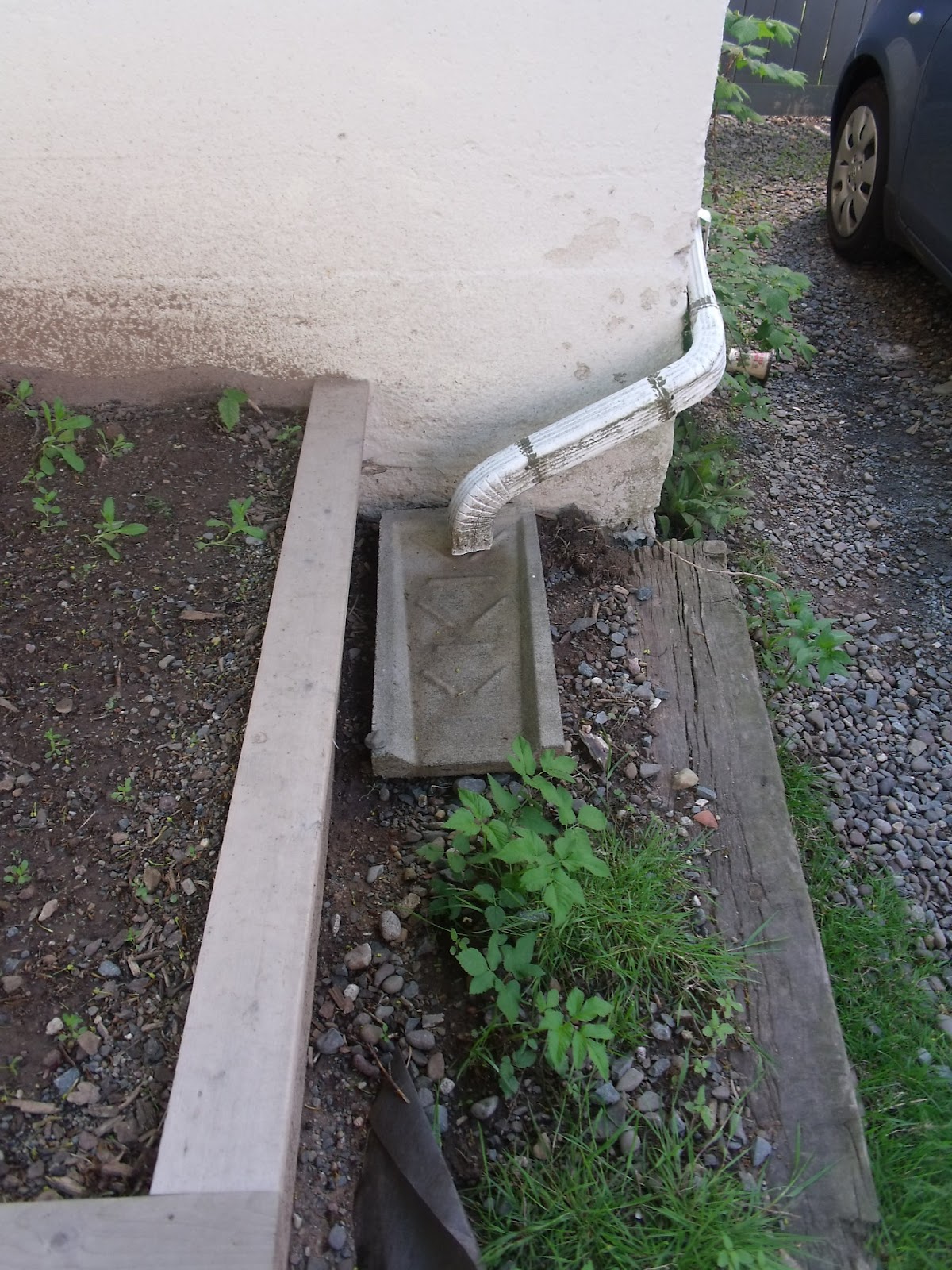
  • Disconnect your downspouts if they are directly connected to your home's sewer system. Place an extension on your downspouts to direct roof runoff at least 4 m away from your house so that water doesn't pool next to your basement. The extension can direct water toward a rain garden or backyard where it can soak into the ground without causing problems. Use a splash pad, pebbles or crushed rock to absorb the impact of water and prevent soil erosion. 
  • A French drain or bioswale can also be used to convey water away from your home. If you have a waterfront property and your runoff is being conveyed directly into a water body, try to add some curves or pooling areas to your conveyance system to slow down the water and allow sediment and other pollutants to settle out. 


Remember to disconnect your downspouts!


Extend your downspout so water drains away from  your house
Use a splash pad to prevent erosion
     2. Let runoff soak into the ground on your property
       

  •      Limit the amount of paved or other hard surfaces. Use permeable pavers, paved driveway strips or gravel for increased driveway permeability.
  •      Direct water toward a rain garden, which should be at least 4 m from your house. Rain gardens work great for everyday rain events, however it is important to consider designing an overflow system (swale or perforated pipe) to help convey excess water toward the street during a heavy rainfall event. 
  •      Soil aeration can reduce compaction and allow better infiltration. Water pooling on your property for an extended period is a good indication that your soil may need aeration.
 

If possible, reduce large paved areas
Modular paving stones, or permeable pavers, allow water to infiltrate into the ground
    3. Capture and reuse water

  •      Place a rain barrel under your disconnected downspouts to capture rooftop runoff. Elevate the barrel above ground level so that a tap or hose can be installed for easy water collection.


Raised rainbarrel system. Photo: The Transplanted Gardener
      Visit  the Canada Mortgage and Housing Corporation website for more practical information on how to improve drainage on your property to avoid basement flooding.

Friday, 18 May 2012

12,000 rain gardens

The Puget Sound region of Washington State is tackling water quality issues with a new campaign to install 12,000 rain gardens by 2016. Once completed, these rain gardens will soak up 160 million gallons of polluted stormwater runoff each year. This innovative campaign offers financial incentives and comprehensive educational materials to neighbourhoods as a way to encourage individuals to do their own part to reduce the amount of pollutants entering the environment while solving drainage problems around their own homes. By encouraging individuals to become neighbourhood champions and recruit others, entire neighbourhoods are coming together to learn about and install rain gardens.The campaign currently has 706 raingardens installed.

Check out the website to find some great resource materials and learn more about the program.

Thursday, 3 May 2012

Constructed wetlands

"S" shaped constructed wetland
At the headwaters of Frenchman's Creek in Dartmouth, a wetland was constructed to treat stormwater runoff from the adjacent sports fields and parking lot. The wetland has a serpentine shape and varying depths in order to maximize residence time of the runoff in the wetland. This allows for increased removal of nutrients and metals through plant uptake and adsorption. This stormwater treatment feature essentially acts as a kidney purifying the water. The runoff leaving this site now enters the natural environment at a much higher quality than it would if directly released without treatment. 


This wetland would require occasional maintenance to maximize function. Construction was done by Jeff Pinhey and Rob Leblanc in 2007. 

The marsh is predominantly vegetated with cattails