Tuesday, 15 April 2014

Halifax Water Stormwater Fee

There has been much attention paid to the recent stormwater fee that is being charged to residents and businesses in serviced and unserviced areas of HRM[1].  Service in this case refers to water and wastewater services.  Residents in unserviced areas of HRM who would not otherwise be receiving a water bill are particularly upset. At first glance, this is understandable, as their drinking water comes from a well and their wastewater is managed onsite with a septic system.

However even properties in unserviced areas of HRM generate stormwater runoff.  Stormwater is the rain or snowmelt that flows off a roof, driveway, parking lot, paved walkway or any other hard surface on a property.  Outside of peninsular Halifax, stormwater runoff ends up in nearby streams, rivers and lakes without prior treatment.  Since stormwater comes into contact with litter, gasoline, oils, brake pad dust from our cars, pesticides, waste from our pets and many other toxins along its journey, stormwater is a significant source of pollution to our water ways.

There is no question that Halifax Water needs to improve the way it manages stormwater in HRM.  We cannot continue to treat our lakes and rivers as a wastewater facility.  Many of our urban lakes such as Lake Banook, Lake Echo and Oathill Lake have reached, or are quickly reaching, their carrying capacity.  Our enjoyment of these water bodies for fishing, swimming, boating and aesthetic value is being compromised. 

Halifax is not unique in charging a stormwater fee.  Other Canadian cities like Victoria, Edmonton, Kitchener, Mississauga and many others have recognized the need to charge a fee for stormwater management.  The principle that HRM and numerous other cities have recognized is simple: if you receive a service you should pay for it.

The Ecology Action Centre conditionally supports the stormwater fee being collected by Halifax Water in order to address inadequacies in our current stormwater management system.  The conditions are:
  • The stormwater fee is used to maintain and improve stormwater infrastructure, especially where it has been neglected or under-maintained.
  •  Halifax Water starts using low impact development (LID) approaches, such as rain gardens, bioswales and constructed wetlands for managing stormwater (others discussed on this blog) .  LID approaches are more cost effective and achieve better environmental outcomes than conventional approaches, and
  • Residential, commercial and institutional customers can receive a fee assessment and rebate if they use stormwater management techniques that infiltrate 100% of runoff on site and do not contribute any additional stormwater to the system.  Financial incentive systems such as the ones implemented in Waterloo and Kitchener, ON are excellent examples.
Rain garden built on Dahousie campus, summer 2013
We need to do better than piping and ditching for stormwater conveyance.  We need to implement innovative stormwater options that act as treatment systems, recharge groundwater and provide habitat for birds, pollinators and other urban wildlife.

Adopting LID approaches would lead to many direct environmental benefits such as improved flood control, increased fish populations, water quality that meets recreational swimming standards, and enhancement of future drinking water supplies through increased groundwater recharge.

The Ecology Action Centre is organizing an educational and hands-on workshop series to help property owners understand the breadth of LID options for managing stormwater on-site.  The first workshop is a walking tour of a rain garden and other stormwater options on Thursday April 24th at 6 PM.  Please click here for more information. 

Tuesday, 1 April 2014

New Video Series: Innovations in Stormwater Management

A new new video series entitled Innovations in Stormwater Management, was recently produced by Dr. Hans Schreier and the Master of Land and Water Systems program at the University of British Columbia.

The series is made up of 4 short videos that explore innovative stormwater management at the property, neighborhood and watershed scale.  A fourth video provides an introduction and overview of the key concepts.

“The video series is designed to show what individual house owners can do to manage rainfall, reduce their water footprint and minimize surface runoff from their property. At the neighborhood scale, we feature municipal innovations that deal with roads and parking lot runoff; and at the watershed scale, we address the cumulative effects and the options to reduce all impacts from urban activities," explains Julie Wilson, Academic Coordinator, Master of Land and Water Systems Program at the University of BC. Julie Wilson is the narrator and producer of the video series.

Video Team: Julie Wilson, Duncan McHugh and Hans Schreier, Faculty of Land & Food System, U.B.C.

"It was a pleasure to showcase some of the local champions of low impact designs for urban rainwater and stormwater management in this video series,” states Dr. Hans Schreier, Emeritus Professor, Faculty of Land and Food Systems at the University of British Columbia. “Our interactive map shows all of our featured locations, and this is just a drop in the bucket in terms of what is out there!”

“Given the increase in climatic variability and urban land use intensification, it is high time that we promote innovations that deal with increasing flooding events and urban pollution. The video series features what some of the leaders in innovative stormwater management are doing in the Metro Vancouver region.”

“This is our first attempt in trying to translate science into actions in the hope that these innovations will be increasingly mainstream in the future,” concludes Hans Schreier.

Click here to access the video series (http://mlws.landfood.ubc.ca/videos/)

Thursday, 20 February 2014

Rain Garden Workshop Follow Up- Resources

Whether you were able to attend the Rain Garden Planning Workshop this past Tuesday evening or not, we think you'll find the resources we discussed very useful if you do decide to plan and build a rain garden in 2014.

Call Before You Dig
We talked about the importance of locating buried infrastructure such as gas and water lines. This is often called "Call Before You Dig." Here in Halifax, you'll need the following information:

Heritage Gas: 1-866-313-3030
Halifax Water: http://www.halifax.ca/hrwc/CallBeforeYouDig.html Go here to download, fill out and submit the Locates Request Form. Only call to follow up once the form has been submitted.
Bell Aliant: 1-800-332-3333

Rain Garden Guides
Once you're sure you are not going to hit anything important while digging, you can get on to siting and planning your garden. We talked about siting considerations, determining the rain catchment area, soil type, slope and sizing of rain gardens. There are many great rain garden handbooks and manuals freely available online. A good one should discuss all of these factors in detail. The ones below are thorough and clear with great diagrams. 

The Vermont Rain Garden Manual “Gardening to Absorb the Storm” http://www.uvm.edu/seagrant/sites/uvm.edu.seagrant/files/vtraingardenmanual.pdf
Rain Garden Layouts from Maine http://www.maine.gov/dep/land/stormwater/stormwaterbmps/vol1/appendixa.pdf from Maine Stormwater Best Management Practices Manual found here http://www.maine.gov/dep/land/stormwater/stormwaterbmps/
The New Jersey Rain Garden Manual

Evergreen Native Plant Database
Many of the plants listed in them will be relevant, but we recommend using the Evergreen Native Plant Database Advanced Search function to determine whether a plant is native to Nova Scotia. You can also use it to sort other plant characteristics like colour, sun and soil preferences, and uses such as wildlife habitat creation or property shading. 

Useful Books Available at the Halifax Public Libraries
Best Garden Plants for Atlantic Canada by Duncan Kelbough and Alison Beck http://discover.halifaxpubliclibraries.ca/?itemid=|library/m/halifax-horizon|1558998

Creating Rain Gardens by Cleo Woelfle-Erskine and Apryl Uncapher http://discover.halifaxpubliclibraries.ca/?itemid=|library/m/halifax-horizon|1766234

Thursday, 6 February 2014

Plan Your Home Rain Garden Workshop

Got the Mid-Winter Blues? Start your spring rain garden planning with us on Tuesday February 18th, 2014 in the Ecology Action Centre kitchen from 7:00 - 8:30 pm. 

We’ll get you started with design tips and criteria, and have resource books and videos on hand to get you on your way to implementing your own beautiful rain garden.  Rain gardens are designed to receive stormwater from your property before it reaches the road.  They help to filter water by capturing contaminants and keep them out of our local waterways.  They also provide native Nova Scotian habitat for amphibians, pollinators and birds, and recharge urban aquifers. Click here to register


Tuesday, 12 November 2013

Rain Garden Plants

The Plants
One of the most exciting things about rain gardens is the opportunity they provide to plant native species in urban areas, thus helping to restore urban habitat for birds and pollinators like bumblebees and butterflies. We’ve pulled together a list of species that have been used in rain gardens in Nova Scotia and Maine here.

Plant Common Name
Plant Latin Name
Dwarf Goat's Beard
Aruncus aethusifolius
Woods Purple New York Aster
Aster novi-belgii
Blue Flag Iris
Iris veriscolor
Switch Grass
Panicum Virgatum
Hard Sheild Fern
Polystichum aculeatum
Goldsturm Black-Eyed Susan
Rudbeckia fulgida "Goldsturm"
Red twig Dogwood
Cornus sericea
Sweet Flag
Acorus americanus
Swamp Milkweed
Asclepius incarnata
Marsh Marigold
Caltha palustris
White Turtle Head
Chelone glabra
Christmas Fern
Polystichum acrostichoides
New England Aster
Symphyotrichum novae-angliae
Vernal Witch Hazel
Hamamelis vernalis
Native Rhododendron
Rhododendron canadense
Labrador tea
Ledum groenlandicum
Winterberry
Ilex verticillata
Royal fern
Osmunda regalis
Native Columbine
Aquilegia canadensis
Sensitive Fern
Onoclea sensibilis
Cardinal Flower
Lobelia cardinalis
Sweet Fern
Comptonia peregrina
Bearberry
Arctostaplylos uva-ursi
Wild geranium
Geranium maculatum
Northern Maidenhair Fern
Adiantum pedatum
Joe Pye Weed
Eupatorium maculatum
Serviceberry
Amelanchier canadensis
Bayberry
Myrica pensylvanica
Blood root
Sanguinaria canadensis
Wild raisin
Viburnum nudum

When selecting plants, consider its growing preferences and features:
·         Native or non-native?
·         Sun or shade
·         Acidic or alkaline soils
·         Nitrogen fixer?
·         Full-size shape & size
·         Moisture tolerance
·         Edible/medicinal?
·         Wildlife benefits?

The Dalhousie rain garden features:
Sweetfern (Comptonia peregrina)
Serviceberry (Amelanchier canadensis)
Bayberry (Myrica pensylvanica)
Blue Flag Iris (Iris versicolor)
Joe Pye Weed (Eupatorium maculatum)
Black Eyed Susan (Rudbeckia fulgida)
Foam Flower (Tiarella cordifolia)
Christmas Fern (Polystichum acrostichoides)
Ostrich Fern (Matteuccia struthiopteris)
Sensitive Fern (Onoclea sensibilis)

The Evergreen Native Plant Database is a great tool for learning about and choosing native plants. If you really want to be sure a plant is native to Nova Scotia and learn about its natural habitat, consult Roland’s tome, The Flora of Nova Scotia, available online here: Part 1 and Part 2.

It can be a challenge to find sources of native plants, and even as the garden was being planned, some nurseries were closing. Here’s a list of nurseries in Nova Scotia that supply native plants suitable for rain gardens.

Baldwin Nurseries Falmouth, NS 798-9468 www.baldwinnurseries.com
Blomidon Nurseries Wolfville, NS 542-2295 www.blomidonnurseries.net/home
Bunchberry Nurseries Upper Clements, NS 532-7777 www.bunchberrynurseries.ca/
Oceanview Garden and Landscaping Chester, NS 275-2505 www.plantcrazy.ca

Ouestville Perennials West Pubnico, NS 762-3198 www.ouestvilleperennials.com

Wednesday, 16 October 2013

Dalhousie Rain Garden is Complete!


There’s a new rain garden in town! With funding from TD Friends of the Environment, the Coastal and Water Team at the EAC was able to partner with Dalhousie’s Office of Sustainability to build a rain garden on the Dalhousie Campus.  Our site is a challenging one, in that it receives high flows of stormwater during heavy rains, enough to cause basement flooding of several buildings down the hill toward the Northwest Arm. The garden is located at the intersection of Coburg Rd and Oxford Rd, at the School of Social Work ‘house-turned-office’.  While our goal was initially to build a rain garden that demonstrates that this is an accessible DIY project for homeowners, this site and the design it required moved the project out of the DIY category!  However, there are many aspects of the design and build process that still apply to a homeowner excited about a rain garden sized for capturing rainwater from a roof via a downspout or two.

Our Process & Design
First, we assessed the site, which means that we looked at a variety of factors that will influence how water moves over the site. This includes soil type and drainage properties, slope, and the size of the rain catchment area. Check out previous rain garden how-to posts here for details on these steps.

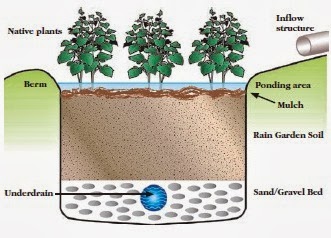
Our calculations showed that we needed a very large garden to absorb all the stormwater which we calculated flowed onto the site. In fact, the calculated area was larger than the area we had available! In addition, we found the slope of the site to be steeper than the suggested 12% for rain gardens in even the flattest area. This meant that we had to increase the capacity of the garden not by surface area, but by depth. The garden is 24 inches deep, whereas most rain gardens are 6-8 inches deep. To increase the porous volume in the garden, we filled the depression to a depth of 14 inches of clear stone, which would hold water in the bottom of the garden, while also holding soil on top. The cross-sectional design looked much like this diagram, from the Fairfax County Virginia website (Figure 1).
Figure 1. Approximate cross-sectional view of the rain garden at Dalhousie.

We used drainage tile (underdrain in the diagram) to move the stormwater that flows from the road and sidewalk over the steep hillside into the rain garden. See the photo below (Figure 2).


Figure 2. In the middle of this photo, the drainage tile is sticking out of the clear stone in the middle of the garden. The tile extends back to where the volunteers are sitting on the slope to catch water flowing down the slope and direct it into the rain garden.

In this photo (Figure 2) you can see how deep the garden is and just how much clear stone is at the bottom. And another key design feature is starting to form: the berm! The berm is essential in a garden of this size, on this slope, and so close to the house. The berm will help retain the water in the garden while it pools and infiltrates. Below (Figure 3) you can see how the berm has been planted with larger native shrubs such as sweet fern and bayberry, as well as a serviceberry tree. As these plants establish, they will help anchor the berm in place. To increase the strength of the berm, it was constructed out of sod mats from the beginning of excavation. Each layer was tamped down, and then new sod was staked into the backside of the berm all the way around the edge of the garden.

Figure 3. The depth of the garden, the volume of clear stone and the berm are all clear in this photo.

Another unique feature of the garden can be seen from the photo (Figure 4) of the completed garden below: the centre of the garden is actually filled with clear stone and then beach stone all the way to the surface. The goal of this design is to allow water which rushes down the slope from Coburg Rd to first hit the beach stone, which will slow down the flow. Then it will make its way to this holding pond in the centre, and as that space fills, the water will first infiltrate horizontally into the soil and plant roots, and then only when it is really full will the water flow over the surface of the mulch and soil, up to the height of the berm. The water will be slowed to the point where it can infiltrate into the groundwater.


Figure 4. The back portion of the completed garden contains stone all the way to the surface, with native shrubs planted in the berm.

Stay tuned to the blog over the coming weeks to learn more about the plants we used and how we chose them, as well as thoughts about rain gardens functioning as marine protective areas, coastal erosion prevention tools, and social activities.

Friday, 20 September 2013

The Urban Stormwater and Aquifer Improvement Project

Great news!  This year, the EAC has launched a project in Porters Lake aiming to explore innovative stormwater management practices in new residential developments.  The project will involve collaborating with the local community and discussing water, stormwater management, and building healthy water neighbourhoods. We will share results from our pilot site, a new development that is implementing low impact development practices.  We will be monitoring groundwater levels and surface water quality around this new development as it is built and during ongoing construction.  This project is an exciting collaboration between an environmental organization, a developer, university and a community to explore how innovative stormwater management techniques can improve groundwater availability and surface water quality.  We are very proud to share this project with you.

(Photo: during a site visit the team stopped by Bell Lake- Jenny and Rob from the Centre for Water Resources Studies (CWRS), Kyle from genivar, Jocelyne from the Ecology Action Centre (EAC), Brad from Seven Lakes, Rick from CWRS, and Jennifer from the EAC).


Public Outreach


Our project is focused on the Porters Lake area, and we want to connect with this community on freshwater issues.  To share information on these topics, we will launch a series of talks in Lake Echo, Porters Lake, and Musqodoboit in fall 2013 and winter-spring of 2014.  Topics include "Healthy rainwater on your property", "How do we know a lake or stream is healthy?" and "Building a healthy water neighbourhood". Dates and locations for the fall talks are nearly confirmed, so stay tuned to this site so you can attend these events.  Stay tuned for more talks and events in the winter and spring of 2014!


Community Showcase


Bell Lake, in the community of Porters Lake
The EAC believes that seeing is believing, and we have the rain gardens, stormwater demonstration sites and living shorelines to prove it!  The EAC is keen to be working with a developer in the Halifax Regional Municipality using low impact development and open-space principles in their planning.  The Villages of Seven Lakes are in the beginning stages of development in the Porters Lake.  We encourage you to explore their website to find out about their design ideas which include 60% open space, clustered communities, rain gardens, bioswales, and infiltration areas for managing stormwater, innovative stormwater management systems, wetland restoration, tertiary wastewater treatment and many more interesting features.


Research

We are very fortunate to work with a developer that is keen to have ongoing monitoring of their development on lakes and groundwater near their sites.  We have partnered with the Dalhousie Centre for Water Resources Studies who will help us understand the natural conditions of lake and groundwater before homes and roads are built.  They will generate digital models of the site and the impact it has on the surrounding water systems.  These impacts will be compared to that of a conventional development using computer modeling.  This is the beginning of a long and beautiful relationship that will help us understand and hopefully promote low impact development practices elsewhere in HRM and Nova Scotia.

We would love to know your thoughts on stormwater in your community and on your property.  Consider taking our short survey to help us learn more!

Stay tuned for updates on this project, and for information on upcoming talks.