Showing posts with label stormwater treatment. Show all posts

Wednesday, 16 October 2013

Dalhousie Rain Garden is Complete!


There’s a new rain garden in town! With funding from TD Friends of the Environment, the Coastal and Water Team at the EAC was able to partner with Dalhousie’s Office of Sustainability to build a rain garden on the Dalhousie Campus.  Our site is a challenging one, in that it receives high flows of stormwater during heavy rains, enough to cause basement flooding of several buildings down the hill toward the Northwest Arm. The garden is located at the intersection of Coburg Rd and Oxford Rd, at the School of Social Work ‘house-turned-office’.  While our goal was initially to build a rain garden that demonstrates that this is an accessible DIY project for homeowners, this site and the design it required moved the project out of the DIY category!  However, there are many aspects of the design and build process that still apply to a homeowner excited about a rain garden sized for capturing rainwater from a roof via a downspout or two.

Our Process & Design
First, we assessed the site, which means that we looked at a variety of factors that will influence how water moves over the site. This includes soil type and drainage properties, slope, and the size of the rain catchment area. Check out previous rain garden how-to posts here for details on these steps.

Our calculations showed that we needed a very large garden to absorb all the stormwater which we calculated flowed onto the site. In fact, the calculated area was larger than the area we had available! In addition, we found the slope of the site to be steeper than the suggested 12% for rain gardens in even the flattest area. This meant that we had to increase the capacity of the garden not by surface area, but by depth. The garden is 24 inches deep, whereas most rain gardens are 6-8 inches deep. To increase the porous volume in the garden, we filled the depression to a depth of 14 inches of clear stone, which would hold water in the bottom of the garden, while also holding soil on top. The cross-sectional design looked much like this diagram, from the Fairfax County Virginia website (Figure 1).
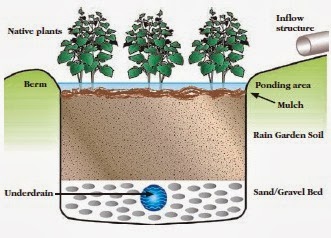
Figure 1. Approximate cross-sectional view of the rain garden at Dalhousie.

We used drainage tile (underdrain in the diagram) to move the stormwater that flows from the road and sidewalk over the steep hillside into the rain garden. See the photo below (Figure 2).


Figure 2. In the middle of this photo, the drainage tile is sticking out of the clear stone in the middle of the garden. The tile extends back to where the volunteers are sitting on the slope to catch water flowing down the slope and direct it into the rain garden.

In this photo (Figure 2) you can see how deep the garden is and just how much clear stone is at the bottom. And another key design feature is starting to form: the berm! The berm is essential in a garden of this size, on this slope, and so close to the house. The berm will help retain the water in the garden while it pools and infiltrates. Below (Figure 3) you can see how the berm has been planted with larger native shrubs such as sweet fern and bayberry, as well as a serviceberry tree. As these plants establish, they will help anchor the berm in place. To increase the strength of the berm, it was constructed out of sod mats from the beginning of excavation. Each layer was tamped down, and then new sod was staked into the backside of the berm all the way around the edge of the garden.

Figure 3. The depth of the garden, the volume of clear stone and the berm are all clear in this photo.

Another unique feature of the garden can be seen from the photo (Figure 4) of the completed garden below: the centre of the garden is actually filled with clear stone and then beach stone all the way to the surface. The goal of this design is to allow water which rushes down the slope from Coburg Rd to first hit the beach stone, which will slow down the flow. Then it will make its way to this holding pond in the centre, and as that space fills, the water will first infiltrate horizontally into the soil and plant roots, and then only when it is really full will the water flow over the surface of the mulch and soil, up to the height of the berm. The water will be slowed to the point where it can infiltrate into the groundwater.


Figure 4. The back portion of the completed garden contains stone all the way to the surface, with native shrubs planted in the berm.

Stay tuned to the blog over the coming weeks to learn more about the plants we used and how we chose them, as well as thoughts about rain gardens functioning as marine protective areas, coastal erosion prevention tools, and social activities.

Thursday, 6 December 2012

Download our Stormwater Brochure

Want to plant the seed for alternative stormwater management with your friends, co-workers or members?  Download our colour brochure here and spread the word!


For a higher resolution version, please contact the Ecology Action Centre.


Friday, 6 July 2012

Lawn care and stormwater pollution

Photo: www.inharmony.com

Pesticides and fertilizers are among the many common pollutants found in stormwater runoff that can impact water quality. When pesticides wash into local waters they contaminate the water and poison aquatic life. Fertilizers contain nutrients such as phosphorus and nitrogen. These nutrients can overload natural water bodies and result in the growth of algal blooms which use up the water's oxygen and impact fish and other aquatic organisms. 

To protect water quality of lakes, rivers and streams it is strongly recommended that property owners reduce or eliminate the use of cosmetic pesticides and fertilizers. You can still have a healthy, happy lawn without the use of chemicals. Here are some tips to protect your lawn and the surrounding environment:
  •  Vinegar is one of the most easily accessible and safest ways to kill weeds. The acetic acid in vinegar breaks down plant cells and kills the top growth.  But, because it does not kill the roots, you’ll have to reapply.   
  • Corn gluten meal, found at lawn and garden centres, acts as both a fertilizer and an all-natural herbicide that is effective at preventing the growth of dandelions and other weeds.  It can be applied to an established lawn in early spring before the weeds germinate.

  • Kitchen compost and lawn waste make excellent natural fertilizer for your lawn. Or better yet, brew your own compost tea!

  • Mow high (6-7 cm) and leave grass clippings on the lawn, which adds nutrients to the soil. The shade of tall, dense grass will overcrowd weeds and reduce growth.
  • Aeration is the best fertilizer. Use an aerator to pull plugs of grass out of your lawn to allow more air to reach the roots. This promotes a healthy lawn and results in vigorous new growth.
  •  Landscape with native species that will have less need for fertilizers and pesticides.
  • Also, remember to pick up after your pets. Pet waste carries numerous bacteria which finds its way into the storm sewer system and ultimately into streams, rivers and lakes.

Tuesday, 12 June 2012

Pioneer Park Stormwater Management Project


The Town of Richmond Hill, Ontario, created a stormwater management park to collect and treat runoff as well as provide flood and erosion protection to neighbouring communities. Originally built in the 1980's, Pioneer Park treated runoff from 26 ha of residential development. Redesigned in 2009/2010, the improved stormwater management park now provides water quality and quantity services to a 740 ha catchment area.

The park consists of a wet pond to treat runoff from everyday rain events, a dry pond to collect and treat runoff from major, intense rainfall events, an oil grit separator for pre-treatment and a channel for fish passage. This project was a 2010 winner of Insurance Bureau of Canada's Watershed Awards.

gallery_image_128.jpg
The completed stormwater management park. Photo: www.rmconstruction.ca
gallery_image_130.jpg
Under construction in 2010. Photo: www.rmconstruction.ca
Check out this great video to learn more about how Pioneer Park was created and the many environmental and economic benefits it provides to the Town of Richmond Hill. This video was provided by Insurance Bureau of Canada.

Thursday, 3 May 2012

Constructed wetlands

"S" shaped constructed wetland
At the headwaters of Frenchman's Creek in Dartmouth, a wetland was constructed to treat stormwater runoff from the adjacent sports fields and parking lot. The wetland has a serpentine shape and varying depths in order to maximize residence time of the runoff in the wetland. This allows for increased removal of nutrients and metals through plant uptake and adsorption. This stormwater treatment feature essentially acts as a kidney purifying the water. The runoff leaving this site now enters the natural environment at a much higher quality than it would if directly released without treatment. 


This wetland would require occasional maintenance to maximize function. Construction was done by Jeff Pinhey and Rob Leblanc in 2007. 

The marsh is predominantly vegetated with cattails

Thursday, 22 March 2012

Engineered Wetlands

Appleton-Middleton Engineered Wetland Photo: www.abydoz.com
When the aging sewage treatment plants needed upgrades in the towns of Appleton and Glenwood in Newfoundland and Labrador, they took an innovative approach to improving stormwater and sewage treatment by implementing an engineered wetland. The towns were concerned  the quality of discharge that was entering the Gander River which was not meeting Provincial or Federal standards and about the increasing maintenance costs required by the older systems.


The newly constructed engineered wetland provides secondary treatment of wastewater, is cost-effective and has greatly improved the water quality discharged into the Gander River. This project was the Atlantic winner of the Watershed Awards, which recognizes community climate change adaptation efforts and is awarded by Insurance Bureau of Canada and the Federation of Canadian Municipalities. Check out this great video to see how the engineered wetland works. Video provided by the Insurance Bureau of Canada.


Thursday, 2 February 2012

Continuous Deflection Separation (CDS)


This week we wanted to find out more about stormwater quality treatment technologies, so we contacted The Shaw Group. They have installed over 150 Continuous Deflection Separation (CDS) systems across the Maritimes. CDS units improve water quality of stormwater runoff by removing sediment, floatables, oil and grease. 

CDS unit (image:www.shawpipe.com)
CDS units have a screen filter that removes all floatable materials and a separate treatment chamber which captures sediment and hydrocarbons. Due to potential high volumes of trapped pollutants, maintenance on these systems is very important. At a minimum they should be maintained twice per year, which includes sucking out the floatable debris and sediment with a vacuum truck.

We went to visit Portland Hills Estates, a large development surrounding Russell Lake, where several CDS units are installed at different stormwater outfalls around the Lake. We saw a ‘56/40 unit’, the largest CDS system which can filter up to 56 cubic feet of water per second.  This system is designed to capture the 1 in 25 year storm (as opposed the 1 in 100 year storm), and as a result it functions very effectively 80% of the time. The other 20% of the time surplus flows through a by-pass valve. 

Let's life the lid and see what is inside!

Wow! Tennis balls, water bottles and several other floatables from the development and neighbouring school are trapped by the CDS. These items would otherwise eventually end up in Russell Lake.
The stormwater outfall is virtually garbage-free!
The impetus for filtering stormwater came from the Russell Lake community group who were concerned about how the Portland Hills Estates development would impact lake water quality. This concern lead to the developer, Clayton Development, including the purchase and installation of these systems into the development agreement. Using these CDS systems is now common practice for Clayton Development.