Friday, 5 September 2014

Rain Garden: Build Your Own in 3 hours!

Rain gardens are the poster child for an emerging trend in stormwater management called low-impact development or LID. LID stands in contrast to conventional stormwater management approaches which focus on collecting and moving water away from properties via drains, pipes, and treatment facilities. The diagram below, from the University of Maryland’s Integration and Application Network, shows a conventional stormwater situation on the left, and a low-impact develop situation on the right.


Essentially, applying LID means thinking creatively about where to allow water to absorb in the city or town. In a natural area, such as a forest, there are so many places for water to go. If you’ve ever felt rain fall from the leaves of a tree long after the rain has stopped, you can begin to imagine how much water a forest can hold. In a city though, we have to recreate places where water can hang out, and slowly evaporate or seep into the ground to form our groundwater. And we need to recreate these places everywhere we can. The water quality of our lakes, rivers and harbours will improve and our groundwater quantity will increase only when LID is everywhere. Every property owner needs to think about recreating these pockets for water to go.

This is where rain gardens come in. They’re the most beautiful, simple, and fun of the low-impact development options (which also include porous paving, more trees, green roofs, swales, rain barrels, and infiltration trenches). Essentially just a bowl-shaped garden with amended soil to improve drainage, they can be easily and quickly built and planted with a wide variety of gardening goals. And a small rain garden designed for receiving the water of one downspout of a home takes only a few hours from start to finish!

This past June, a group of Ecology Action Centre and RBC volunteers and members of the Bloomfield Neighbourhood Residents Association demonstrated just that on Bloomfield St in the North End of Halifax. Many homes in the North End do not have front yards, and may only have a grassy spot to work with in the sidewalk median. While officially city owned land, many people garden there. We thought it was just begging for a rain garden!
The before shot.

There’s a small house just across the sidewalk with a downspout that needs disconnecting. When disconnected, the water will flow across the sidewalk and into the grass. A rain garden will help ensure that the water can be absorbed into the ground, rather than continue its path into the street and storm drain. It is important to consider where the water actually flows, so you can do a test with a hose if you do not want to wait for rain to observe the flow direction. Make sure to calculate the appropriate size by working through this information here.

Once you’ve done the site assessment and sizing work, you can begin digging! Our first step was to remove the sod. You can either dig it up on the day of your rain garden build, or you can kill the grass by smothering it with cardboard over a period of a few weeks. As you can see below, we dug it up by hand. This took us about an hour. We used a sod-cutting edger and several digging shovels, and moved the sod to a compost bin with a wheelbarrow. If you have an uneven site and you need to make a berm, sod is great for building the berm.
Removing the sod.
The garden space with the sod removed.


Garden Bed Preparation
Once the sod is removed, the next step is to dig the garden down so that there is a slight depression in the middle. This is where rain will slow down and settle, to be absorbed into the ground over the next 24 hours. You will also want to think about breaking up the likely compacted soil with a garden fork or rototiller if you have one. This will form more air pockets in the soil to hold water. If your soil is very clayey, then you’ll want to add soil amendments to open up space for water, such as sand and compost.

To determine how deeply to loosen and amend the soil, look at the depth of the plants you have chosen to plant. You’ll want to be able to dig a hole the accommodate the plant’s roots and still be in nice soil. This will probably mean loosening the soil to a depth of 6-8”. Make sure to mix whatever amendments you add thoroughly to this loosened layer of soil.

Planting
Now you are ready to plant. For a small garden, it is not necessary to draw a planting plan. However, it is still important to choose your plants carefully based on the amount of light your garden location recieves, for the climatic zone you live in, and the unique wet-dry conditions of a rain garden. Beyond that, you can choose the plants you want, considering things like blooming time, colour, size, texture and function. You’ll want to decide whether you want the garden to look full right away, in which case you will need more plants, or whether you are happy to wait for the plants to grow and clump to achieve a full look in a year or two.

Next, take your plants, and set them out in their pots, and play with potential patterns before you plant them. Keep in mind each plant’s moisture needs. Plants that can tolerate very wet soil should go in the middle, and plants that need to be kept drier should go on the perimeter. Once you settle on a placement you like, go ahead and dig the holes, one at a time, to fit each plant. Make sure that the base of the plant, where the top meets the root, is just level with the rest of the soil. It’s a good idea to add a mix of nutrients for the plants, such as a mixture of bone meal,  and sea weed to help the plants through transplant shock. It’s also important to water the plants in well, and to water them once a week until they are established. Spread mulch over the garden to hold in moisture, provide another layer of aborptive material, and reduce the weeding you’ll have to do over time.
Rain garden right after completion.

We were able to have most of the plants in the garden donated from nearby gardens. Therefore, not all the plants are native or are a particularly good fit for the wet-dry cycle of a rain garden. If you do end up with plants like this, you can simply place them near the edges of the garden, where the garden will have less moisture. We did this with the donated geraniums, for example. By using donated plants, we spent less than $70 on this small rain garden. So with a few people working for just 2.5 hours and spending very little money, it’s possible to create a rain garden that’s great for water, and great for making your street more beautiful.
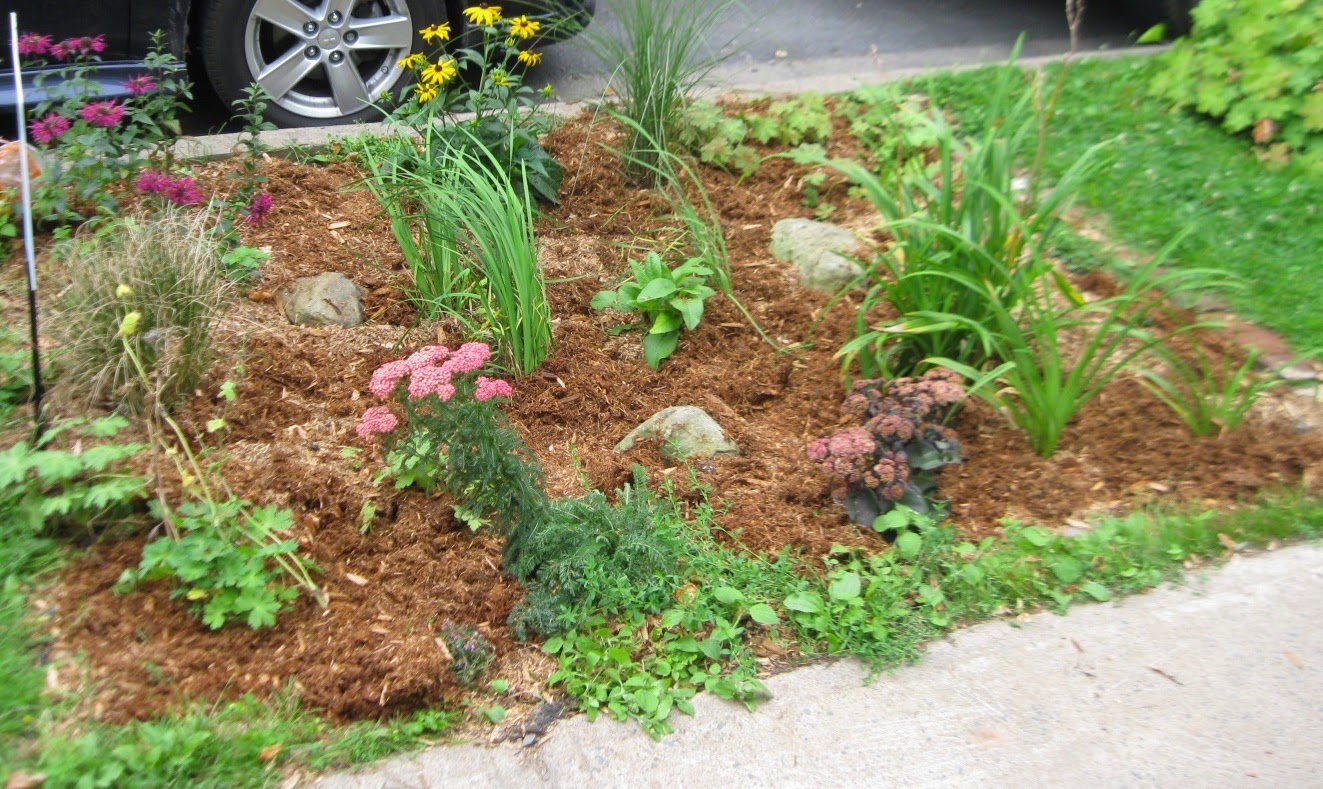

Rain garden in late summer with new mulch and a few new plants.


Tuesday, 15 April 2014

Halifax Water Stormwater Fee

There has been much attention paid to the recent stormwater fee that is being charged to residents and businesses in serviced and unserviced areas of HRM[1].  Service in this case refers to water and wastewater services.  Residents in unserviced areas of HRM who would not otherwise be receiving a water bill are particularly upset. At first glance, this is understandable, as their drinking water comes from a well and their wastewater is managed onsite with a septic system.

However even properties in unserviced areas of HRM generate stormwater runoff.  Stormwater is the rain or snowmelt that flows off a roof, driveway, parking lot, paved walkway or any other hard surface on a property.  Outside of peninsular Halifax, stormwater runoff ends up in nearby streams, rivers and lakes without prior treatment.  Since stormwater comes into contact with litter, gasoline, oils, brake pad dust from our cars, pesticides, waste from our pets and many other toxins along its journey, stormwater is a significant source of pollution to our water ways.

There is no question that Halifax Water needs to improve the way it manages stormwater in HRM.  We cannot continue to treat our lakes and rivers as a wastewater facility.  Many of our urban lakes such as Lake Banook, Lake Echo and Oathill Lake have reached, or are quickly reaching, their carrying capacity.  Our enjoyment of these water bodies for fishing, swimming, boating and aesthetic value is being compromised. 

Halifax is not unique in charging a stormwater fee.  Other Canadian cities like Victoria, Edmonton, Kitchener, Mississauga and many others have recognized the need to charge a fee for stormwater management.  The principle that HRM and numerous other cities have recognized is simple: if you receive a service you should pay for it.

The Ecology Action Centre conditionally supports the stormwater fee being collected by Halifax Water in order to address inadequacies in our current stormwater management system.  The conditions are:
  • The stormwater fee is used to maintain and improve stormwater infrastructure, especially where it has been neglected or under-maintained.
  •  Halifax Water starts using low impact development (LID) approaches, such as rain gardens, bioswales and constructed wetlands for managing stormwater (others discussed on this blog) .  LID approaches are more cost effective and achieve better environmental outcomes than conventional approaches, and
  • Residential, commercial and institutional customers can receive a fee assessment and rebate if they use stormwater management techniques that infiltrate 100% of runoff on site and do not contribute any additional stormwater to the system.  Financial incentive systems such as the ones implemented in Waterloo and Kitchener, ON are excellent examples.
Rain garden built on Dahousie campus, summer 2013
We need to do better than piping and ditching for stormwater conveyance.  We need to implement innovative stormwater options that act as treatment systems, recharge groundwater and provide habitat for birds, pollinators and other urban wildlife.

Adopting LID approaches would lead to many direct environmental benefits such as improved flood control, increased fish populations, water quality that meets recreational swimming standards, and enhancement of future drinking water supplies through increased groundwater recharge.

The Ecology Action Centre is organizing an educational and hands-on workshop series to help property owners understand the breadth of LID options for managing stormwater on-site.  The first workshop is a walking tour of a rain garden and other stormwater options on Thursday April 24th at 6 PM.  Please click here for more information. 

Tuesday, 1 April 2014

New Video Series: Innovations in Stormwater Management

A new new video series entitled Innovations in Stormwater Management, was recently produced by Dr. Hans Schreier and the Master of Land and Water Systems program at the University of British Columbia.

The series is made up of 4 short videos that explore innovative stormwater management at the property, neighborhood and watershed scale.  A fourth video provides an introduction and overview of the key concepts.

“The video series is designed to show what individual house owners can do to manage rainfall, reduce their water footprint and minimize surface runoff from their property. At the neighborhood scale, we feature municipal innovations that deal with roads and parking lot runoff; and at the watershed scale, we address the cumulative effects and the options to reduce all impacts from urban activities," explains Julie Wilson, Academic Coordinator, Master of Land and Water Systems Program at the University of BC. Julie Wilson is the narrator and producer of the video series.

Video Team: Julie Wilson, Duncan McHugh and Hans Schreier, Faculty of Land & Food System, U.B.C.

"It was a pleasure to showcase some of the local champions of low impact designs for urban rainwater and stormwater management in this video series,” states Dr. Hans Schreier, Emeritus Professor, Faculty of Land and Food Systems at the University of British Columbia. “Our interactive map shows all of our featured locations, and this is just a drop in the bucket in terms of what is out there!”

“Given the increase in climatic variability and urban land use intensification, it is high time that we promote innovations that deal with increasing flooding events and urban pollution. The video series features what some of the leaders in innovative stormwater management are doing in the Metro Vancouver region.”

“This is our first attempt in trying to translate science into actions in the hope that these innovations will be increasingly mainstream in the future,” concludes Hans Schreier.

Click here to access the video series (http://mlws.landfood.ubc.ca/videos/)

Thursday, 20 February 2014

Rain Garden Workshop Follow Up- Resources

Whether you were able to attend the Rain Garden Planning Workshop this past Tuesday evening or not, we think you'll find the resources we discussed very useful if you do decide to plan and build a rain garden in 2014.

Call Before You Dig
We talked about the importance of locating buried infrastructure such as gas and water lines. This is often called "Call Before You Dig." Here in Halifax, you'll need the following information:

Heritage Gas: 1-866-313-3030
Halifax Water: http://www.halifax.ca/hrwc/CallBeforeYouDig.html Go here to download, fill out and submit the Locates Request Form. Only call to follow up once the form has been submitted.
Bell Aliant: 1-800-332-3333

Rain Garden Guides
Once you're sure you are not going to hit anything important while digging, you can get on to siting and planning your garden. We talked about siting considerations, determining the rain catchment area, soil type, slope and sizing of rain gardens. There are many great rain garden handbooks and manuals freely available online. A good one should discuss all of these factors in detail. The ones below are thorough and clear with great diagrams. 

The Vermont Rain Garden Manual “Gardening to Absorb the Storm” http://www.uvm.edu/seagrant/sites/uvm.edu.seagrant/files/vtraingardenmanual.pdf
Rain Garden Layouts from Maine http://www.maine.gov/dep/land/stormwater/stormwaterbmps/vol1/appendixa.pdf from Maine Stormwater Best Management Practices Manual found here http://www.maine.gov/dep/land/stormwater/stormwaterbmps/
The New Jersey Rain Garden Manual

Evergreen Native Plant Database
Many of the plants listed in them will be relevant, but we recommend using the Evergreen Native Plant Database Advanced Search function to determine whether a plant is native to Nova Scotia. You can also use it to sort other plant characteristics like colour, sun and soil preferences, and uses such as wildlife habitat creation or property shading. 

Useful Books Available at the Halifax Public Libraries
Best Garden Plants for Atlantic Canada by Duncan Kelbough and Alison Beck http://discover.halifaxpubliclibraries.ca/?itemid=|library/m/halifax-horizon|1558998

Creating Rain Gardens by Cleo Woelfle-Erskine and Apryl Uncapher http://discover.halifaxpubliclibraries.ca/?itemid=|library/m/halifax-horizon|1766234

Thursday, 6 February 2014

Plan Your Home Rain Garden Workshop

Got the Mid-Winter Blues? Start your spring rain garden planning with us on Tuesday February 18th, 2014 in the Ecology Action Centre kitchen from 7:00 - 8:30 pm. 

We’ll get you started with design tips and criteria, and have resource books and videos on hand to get you on your way to implementing your own beautiful rain garden.  Rain gardens are designed to receive stormwater from your property before it reaches the road.  They help to filter water by capturing contaminants and keep them out of our local waterways.  They also provide native Nova Scotian habitat for amphibians, pollinators and birds, and recharge urban aquifers. Click here to register


Tuesday, 12 November 2013

Rain Garden Plants

The Plants
One of the most exciting things about rain gardens is the opportunity they provide to plant native species in urban areas, thus helping to restore urban habitat for birds and pollinators like bumblebees and butterflies. We’ve pulled together a list of species that have been used in rain gardens in Nova Scotia and Maine here.

Plant Common Name
Plant Latin Name
Dwarf Goat's Beard
Aruncus aethusifolius
Woods Purple New York Aster
Aster novi-belgii
Blue Flag Iris
Iris veriscolor
Switch Grass
Panicum Virgatum
Hard Sheild Fern
Polystichum aculeatum
Goldsturm Black-Eyed Susan
Rudbeckia fulgida "Goldsturm"
Red twig Dogwood
Cornus sericea
Sweet Flag
Acorus americanus
Swamp Milkweed
Asclepius incarnata
Marsh Marigold
Caltha palustris
White Turtle Head
Chelone glabra
Christmas Fern
Polystichum acrostichoides
New England Aster
Symphyotrichum novae-angliae
Vernal Witch Hazel
Hamamelis vernalis
Native Rhododendron
Rhododendron canadense
Labrador tea
Ledum groenlandicum
Winterberry
Ilex verticillata
Royal fern
Osmunda regalis
Native Columbine
Aquilegia canadensis
Sensitive Fern
Onoclea sensibilis
Cardinal Flower
Lobelia cardinalis
Sweet Fern
Comptonia peregrina
Bearberry
Arctostaplylos uva-ursi
Wild geranium
Geranium maculatum
Northern Maidenhair Fern
Adiantum pedatum
Joe Pye Weed
Eupatorium maculatum
Serviceberry
Amelanchier canadensis
Bayberry
Myrica pensylvanica
Blood root
Sanguinaria canadensis
Wild raisin
Viburnum nudum

When selecting plants, consider its growing preferences and features:
·         Native or non-native?
·         Sun or shade
·         Acidic or alkaline soils
·         Nitrogen fixer?
·         Full-size shape & size
·         Moisture tolerance
·         Edible/medicinal?
·         Wildlife benefits?

The Dalhousie rain garden features:
Sweetfern (Comptonia peregrina)
Serviceberry (Amelanchier canadensis)
Bayberry (Myrica pensylvanica)
Blue Flag Iris (Iris versicolor)
Joe Pye Weed (Eupatorium maculatum)
Black Eyed Susan (Rudbeckia fulgida)
Foam Flower (Tiarella cordifolia)
Christmas Fern (Polystichum acrostichoides)
Ostrich Fern (Matteuccia struthiopteris)
Sensitive Fern (Onoclea sensibilis)

The Evergreen Native Plant Database is a great tool for learning about and choosing native plants. If you really want to be sure a plant is native to Nova Scotia and learn about its natural habitat, consult Roland’s tome, The Flora of Nova Scotia, available online here: Part 1 and Part 2.

It can be a challenge to find sources of native plants, and even as the garden was being planned, some nurseries were closing. Here’s a list of nurseries in Nova Scotia that supply native plants suitable for rain gardens.

Baldwin Nurseries Falmouth, NS 798-9468 www.baldwinnurseries.com
Blomidon Nurseries Wolfville, NS 542-2295 www.blomidonnurseries.net/home
Bunchberry Nurseries Upper Clements, NS 532-7777 www.bunchberrynurseries.ca/
Oceanview Garden and Landscaping Chester, NS 275-2505 www.plantcrazy.ca

Ouestville Perennials West Pubnico, NS 762-3198 www.ouestvilleperennials.com